
Tuesday, October 31, 2006


Pfizer - torcetrapib: more bad news
Pfizer has reported preliminary results of a late-stage study found its experimental torcetrapib "good" cholesterol drug, when combined with its Lipitor drug, raised blood pressure more than was found in previous studies.
The results show the an average increase in systolic blood pressure of about 1 millimeter of mercury above the 2-to-3 millimeter range seen in earlier studies, the company said.
Hmmm!
Source: Reuters
The results show the an average increase in systolic blood pressure of about 1 millimeter of mercury above the 2-to-3 millimeter range seen in earlier studies, the company said.
Hmmm!
Source: Reuters

Bayer - Trasylol: who knew what and when?
By Marc Greilsamer
Suppressed data? Secret informants? Fall guys? Welcome to the pharmaceutical industry, which is filled with enough mystery and intrigue to satisfy even the most demanding crime-drama aficionado. Yet, the issues that come into play in this gigantic, lucrative industry are quite real–and are certainly matters of life or death.
Questions and accusations are swirling around the German drug maker Bayer A.G., their heart-surgery drug, Trasylol (aprotinin), and the risk of potentially fatal side effects. But what distinguishes this case from most run-of-the-mill drug-safety controversies is the fact that Bayer may have withheld, either intentionally or errantly, pertinent information about Trasylol from the U.S. Food and Drug Administration.
Read the full article at newsinferno.com
Suppressed data? Secret informants? Fall guys? Welcome to the pharmaceutical industry, which is filled with enough mystery and intrigue to satisfy even the most demanding crime-drama aficionado. Yet, the issues that come into play in this gigantic, lucrative industry are quite real–and are certainly matters of life or death.
Questions and accusations are swirling around the German drug maker Bayer A.G., their heart-surgery drug, Trasylol (aprotinin), and the risk of potentially fatal side effects. But what distinguishes this case from most run-of-the-mill drug-safety controversies is the fact that Bayer may have withheld, either intentionally or errantly, pertinent information about Trasylol from the U.S. Food and Drug Administration.
Read the full article at newsinferno.com


Merck pay thru the nose for eye drug company
Merck is buying Sirna Therapeutics, a tiny biotech for $1.1 billion in cash, a premium of more than 100%.
Sirna's lead drug is a treatment for macular degeneration, a leading cause of blindness, and is seen as one of the most promising immediate avenues for RNAi research. That market now is dominated by Genentech, with Lucentis, an expensive version of Avastin .
But Lucentis must be injected into the eye as much as once a month.
Sirna Therapeutics are testing RNAi based blood-vessel blockers for the eye that might not need to be given as frequently as Lucentis, thus limiting the need for unpleasant eye injections.
More at Forbes
Sirna's lead drug is a treatment for macular degeneration, a leading cause of blindness, and is seen as one of the most promising immediate avenues for RNAi research. That market now is dominated by Genentech, with Lucentis, an expensive version of Avastin .
But Lucentis must be injected into the eye as much as once a month.
Sirna Therapeutics are testing RNAi based blood-vessel blockers for the eye that might not need to be given as frequently as Lucentis, thus limiting the need for unpleasant eye injections.
More at Forbes
Monday, October 30, 2006

Pfizer - Exubera: wonder or white elephant?
The air is leaking out of what was supposed to be the next big thing in the treatment of diabetes: inhalable insulin.
"While inhalable insulins will see a reasonable level of uptake, they aren't the surefire blockbuster they were hyped to be," says a new study by British market research firm Datamonitor PLC. It points out that the new treatment isn't significantly better than existing therapies, is expensive and its long-term safety in the lungs is unknown.
On the other hand, inhalable insulin represents a convenient and alternative delivery system for diabetics who have a needle phobia, and are reluctant to inject themselves with insulin to control blood sugar levels in the blood.
The World Health Organization estimates diabetes has infected 194 million people, and predicts the incidence will reach 360 million by 2030. So finding innovative ways to administer insulin promises blockbuster revenues for the pharmaceutical industry.
But this month Pfizer Inc. decided to postpone the widespread rollout of Exubera, its inhaled insulin, and the only product approved for sale. The rollout has been changed to January from November, which will be about 12 months after U.S. regulators cleared the drug. Pfizer cited manufacturing issues as part of the two-month delay.
The world's No. 1 drug maker said it will continue educating 5,000 specialists before kick-starting a marketing campaign to general practitioners. The novelty of the technology requires a big marketing investment by New York-based Pfizer, analysts say. Besides paying France's Sanofi-Aventis SA $1.3-billion (U.S.) for full rights to Exubera, Pfizer has spent more than $700-million to develop the drug.
More at globeandmail.com
"While inhalable insulins will see a reasonable level of uptake, they aren't the surefire blockbuster they were hyped to be," says a new study by British market research firm Datamonitor PLC. It points out that the new treatment isn't significantly better than existing therapies, is expensive and its long-term safety in the lungs is unknown.
On the other hand, inhalable insulin represents a convenient and alternative delivery system for diabetics who have a needle phobia, and are reluctant to inject themselves with insulin to control blood sugar levels in the blood.
The World Health Organization estimates diabetes has infected 194 million people, and predicts the incidence will reach 360 million by 2030. So finding innovative ways to administer insulin promises blockbuster revenues for the pharmaceutical industry.
But this month Pfizer Inc. decided to postpone the widespread rollout of Exubera, its inhaled insulin, and the only product approved for sale. The rollout has been changed to January from November, which will be about 12 months after U.S. regulators cleared the drug. Pfizer cited manufacturing issues as part of the two-month delay.
The world's No. 1 drug maker said it will continue educating 5,000 specialists before kick-starting a marketing campaign to general practitioners. The novelty of the technology requires a big marketing investment by New York-based Pfizer, analysts say. Besides paying France's Sanofi-Aventis SA $1.3-billion (U.S.) for full rights to Exubera, Pfizer has spent more than $700-million to develop the drug.
More at globeandmail.com


Steve Nissen headlines Windhover's FDA/CMS Summit
The Food and Drug Administration’s (FDA) approach to drug safety is headed for significant changes in the wake of several high-profile drug withdrawals, critiques of the advisory committee process, and pending legislation to revamp its review procedures. These changes will have a lasting impact on the companies that develop and market regulated drugs.
Steven E. Nissen, M.D., FACC, Chairman of the Department of Cardiovascular Medicine at Cleveland Clinic, will headline an in-depth discussion of the changes underway and in consideration for the FDA’s drug evaluation and safety assessment procedures at Windhover’s FDA/CMS Summit.
The Summit will take place Dec. 4-5 in Washington, DC. Online registration is available at www.windhover.com/fda-cms.
Nissen, a former member of FDA’s Cardiovascular and Renal Drugs Advisory Committee and a key figure in the Cleveland Clinic’s emergence as a major clinical trials site, is a leading academic advocate for changes in FDA’s approach to assessing drug safety.
He coauthored an analysis of FDA’s review of Bristol-Myers Squibb’s Pargluva new drug application that coincided with the agency’s decision not to approve the drug.
Additionally, following the release of the recent Institute of Medicine review of the U.S. drug safety system, Nissen called for randomized trials when safety signals arise and for FDA to “raise the bar” on approval standards for first-in-class drugs.
Dr. Nissen’s outside perspective will complement those of top FDA policymakers, including acting Commissioner Andrew von Eschenbach, MD, Deputy Commissioners Janet Woodcock, MD, and Scott Gottlieb, MD, and Center for Drug Evaluation & Research Director Steven Galson, MD.
The summit comes at a watershed point for FDA -- one month after the Congressional elections will usher in a new Congress with an intensified focus on the agency. The FDA/CMS Summit will help pharmaceutical executives identify the issues at stake for the agency and its regulated industry constituents.
A complete agenda and registrations for the summit are available at www.windhover.com/fda-cms.
The FDA/CMS Summit is designed as a unique opportunity for face-to-face dialogues with top policymakers and executives. It is designed for industry executives in all areas of responsibility who want to create successful strategies for dealing with FDA and CMS. Attendees will get practical, real-life lessons from some of the most experienced pharmaceutical and biotechnology executives on how they handle regulatory obstacles, and will also be able to benchmark their regulatory strategy against all the major pharmaceutical and biotechnology companies.
To register for the summit, contact Alexandria Riley at (203) 838-4401 ext. 113 or ariley@windhover.com; or register on the FDA-CMS Conference website at www.windhover.com/fda-cms.
Steven E. Nissen, M.D., FACC, Chairman of the Department of Cardiovascular Medicine at Cleveland Clinic, will headline an in-depth discussion of the changes underway and in consideration for the FDA’s drug evaluation and safety assessment procedures at Windhover’s FDA/CMS Summit.
The Summit will take place Dec. 4-5 in Washington, DC. Online registration is available at www.windhover.com/fda-cms.
Nissen, a former member of FDA’s Cardiovascular and Renal Drugs Advisory Committee and a key figure in the Cleveland Clinic’s emergence as a major clinical trials site, is a leading academic advocate for changes in FDA’s approach to assessing drug safety.
He coauthored an analysis of FDA’s review of Bristol-Myers Squibb’s Pargluva new drug application that coincided with the agency’s decision not to approve the drug.
Additionally, following the release of the recent Institute of Medicine review of the U.S. drug safety system, Nissen called for randomized trials when safety signals arise and for FDA to “raise the bar” on approval standards for first-in-class drugs.
Dr. Nissen’s outside perspective will complement those of top FDA policymakers, including acting Commissioner Andrew von Eschenbach, MD, Deputy Commissioners Janet Woodcock, MD, and Scott Gottlieb, MD, and Center for Drug Evaluation & Research Director Steven Galson, MD.
The summit comes at a watershed point for FDA -- one month after the Congressional elections will usher in a new Congress with an intensified focus on the agency. The FDA/CMS Summit will help pharmaceutical executives identify the issues at stake for the agency and its regulated industry constituents.
A complete agenda and registrations for the summit are available at www.windhover.com/fda-cms.
The FDA/CMS Summit is designed as a unique opportunity for face-to-face dialogues with top policymakers and executives. It is designed for industry executives in all areas of responsibility who want to create successful strategies for dealing with FDA and CMS. Attendees will get practical, real-life lessons from some of the most experienced pharmaceutical and biotechnology executives on how they handle regulatory obstacles, and will also be able to benchmark their regulatory strategy against all the major pharmaceutical and biotechnology companies.
To register for the summit, contact Alexandria Riley at (203) 838-4401 ext. 113 or ariley@windhover.com; or register on the FDA-CMS Conference website at www.windhover.com/fda-cms.
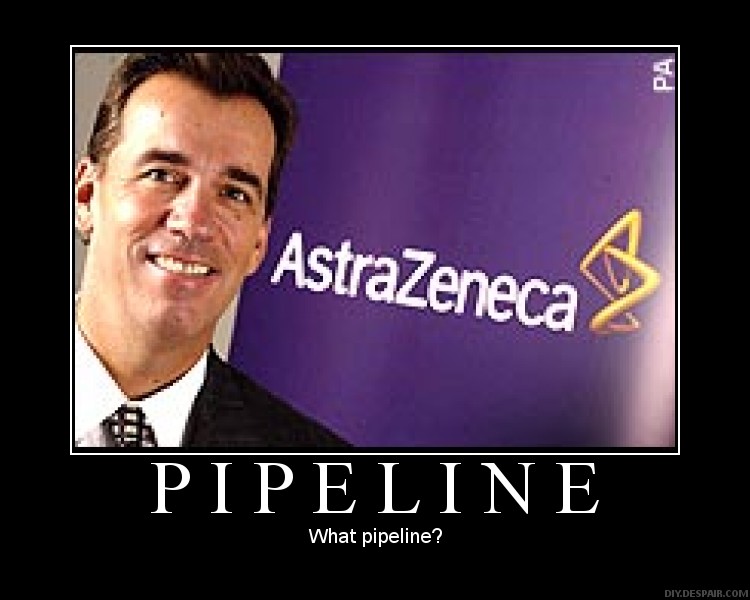
GlaxoSmithKlineAstraZeneca?
Faced with disappointments in its research labs and slowing growth of top sellers Advair and Avandia in the United States, GlaxoSmithKline may turn to deals to bolster its fortunes.
"The most obvious strategy that the group could adopt to help alleviate these pressures is to act as an industry consolidator, and we view this as reasonably probable," said brokerage Credit Suisse.
Europe's biggest drugmaker unnerved investors recently by announcing delays for cervical cancer vaccine Cervarix and platelet-booster Promacta, the scrapping of a drug for sepsis and poor data on experimental diabetes pill Redona.
That eclipsed strong third-quarter profits and an upgrade in the group's 2006 earnings forecast.
As a result, the shares have fallen more than six per cent in the last two days.
Insider's view: A merger with AZ could happen if GSK have any more bad news in the pipeline.
There would be useful "synergies". GSK would bolster their oncology and CV franchises. The job cut savings (especially in the UK and US) would be significant.
Soon to retire Chief Executive Jean-Pierre Garnier has previously argued that delivering on Glaxo's large portfolio of experimental drugs is the top priority and he will not be distracted by pursuing large, or transformational, deals.
On the other hand, he has said that consolidation in the industry is inevitable.
Further failures or substantial slippage on new product development could force his hand.
"The most obvious strategy that the group could adopt to help alleviate these pressures is to act as an industry consolidator, and we view this as reasonably probable," said brokerage Credit Suisse.
Europe's biggest drugmaker unnerved investors recently by announcing delays for cervical cancer vaccine Cervarix and platelet-booster Promacta, the scrapping of a drug for sepsis and poor data on experimental diabetes pill Redona.
That eclipsed strong third-quarter profits and an upgrade in the group's 2006 earnings forecast.
As a result, the shares have fallen more than six per cent in the last two days.
Insider's view: A merger with AZ could happen if GSK have any more bad news in the pipeline.
There would be useful "synergies". GSK would bolster their oncology and CV franchises. The job cut savings (especially in the UK and US) would be significant.
Soon to retire Chief Executive Jean-Pierre Garnier has previously argued that delivering on Glaxo's large portfolio of experimental drugs is the top priority and he will not be distracted by pursuing large, or transformational, deals.
On the other hand, he has said that consolidation in the industry is inevitable.
Further failures or substantial slippage on new product development could force his hand.
Is Big Pharma burying bad data?
There is growing criticism of Big Pharma for failing to disclose results of clinical studies; especially studies that provide information about the safety or effectiveness of medicines being taken by consumers.
The charges became especially heated during the recent debate about the safety of antidepressants and the withdrawal of the once-popular painkiller Vioxx, which spurred accusations that, in some cases, side-effect data were suppressed.
The issue has prompted scrutiny from some members of Congress and calls by the editors of several leading medical journals to require greater, and quicker, disclosure of clinical trials.
Take the case of GSK and two trials of Valtrex vs Famvir, in genital herpes.
The trials finished in 1998, but the were only published last month.
The lead researcher for the studies complained she was never given a satisfactory explanation, and noted the drugmaker responsible for the delay also owns the medicine that fared poorly.
"I was given all sorts of reasons," said Anna Wald, a professor of medicine at the University of Washington, whose work comparing the two drugs was recently published in the journal Sexually Transmitted Diseases.
"It took years to receive any material," she said. "They should have moved faster."
The charges became especially heated during the recent debate about the safety of antidepressants and the withdrawal of the once-popular painkiller Vioxx, which spurred accusations that, in some cases, side-effect data were suppressed.
The issue has prompted scrutiny from some members of Congress and calls by the editors of several leading medical journals to require greater, and quicker, disclosure of clinical trials.
Take the case of GSK and two trials of Valtrex vs Famvir, in genital herpes.
The trials finished in 1998, but the were only published last month.
The lead researcher for the studies complained she was never given a satisfactory explanation, and noted the drugmaker responsible for the delay also owns the medicine that fared poorly.
"I was given all sorts of reasons," said Anna Wald, a professor of medicine at the University of Washington, whose work comparing the two drugs was recently published in the journal Sexually Transmitted Diseases.
"It took years to receive any material," she said. "They should have moved faster."
Sunday, October 29, 2006


The Dixie Chicks movie trailer that NBC wont show
What happened to freedom of speech? Thank heaven for YouTube!
Saturday, October 28, 2006
Big Pharma pays back the Republicans for Medicare Part D
The Wall Street Journal on Wednesday examined how pharmaceutical companies are "pouring millions of dollars" into congressional campaigns in close races, "giving some Republicans a financial edge."
According to the Journal, "with a Democratic victory increasing likely, few recent elections have been so critical" for pharmaceutical companies, in large part because Democrats have promised to revise the Medicare prescription drug benefit to "take away most of the advantages it handed to pharmaceutical companies."
House Minority Leader Nancy Pelosi (D-Calif.) has said that Democrats, in the event that they take control of the House, within the first 100 hours will seek to revise the Medicare prescription drug benefit to allow the federal government to negotiate directly with pharmaceutical companies for discounts on medications.
In addition, Democrats have proposed "lifting a ban on the broad-scale reimporting of inexpensive drugs," and they might seek to "toughen the drug-approval process," the Journal reports. Democrats also have discussed "holding hearings into conflicts of interest among Republican now working" for the pharmaceutical industry, according to the Journal.
In response, pharmaceutical companies have contributed millions of dollars to Republicans in close congressional races and to those who have supported favorable policies.
As of early September, pharmaceutical industry political action committees had contributed about $8.7 million to congressional campaigns, compared with $7 million for all of 2002, according to the Center for Responsive Politics, a nonpartisan research group.
Republicans have received 69% of the campaign contributions from the pharmaceutical industry this year.
According to the Journal, "with a Democratic victory increasing likely, few recent elections have been so critical" for pharmaceutical companies, in large part because Democrats have promised to revise the Medicare prescription drug benefit to "take away most of the advantages it handed to pharmaceutical companies."
House Minority Leader Nancy Pelosi (D-Calif.) has said that Democrats, in the event that they take control of the House, within the first 100 hours will seek to revise the Medicare prescription drug benefit to allow the federal government to negotiate directly with pharmaceutical companies for discounts on medications.
In addition, Democrats have proposed "lifting a ban on the broad-scale reimporting of inexpensive drugs," and they might seek to "toughen the drug-approval process," the Journal reports. Democrats also have discussed "holding hearings into conflicts of interest among Republican now working" for the pharmaceutical industry, according to the Journal.
In response, pharmaceutical companies have contributed millions of dollars to Republicans in close congressional races and to those who have supported favorable policies.
As of early September, pharmaceutical industry political action committees had contributed about $8.7 million to congressional campaigns, compared with $7 million for all of 2002, according to the Center for Responsive Politics, a nonpartisan research group.
Republicans have received 69% of the campaign contributions from the pharmaceutical industry this year.

GSK - Requip: disease mongering 101
From Oligopoly Watch:
"So what if people are treating their cholesterol, high-blood pressure, and arthritis with generic medicines. The big drugmakers will press on, not finding cures for known diseases, but rather finding diseases for known cures. "
How true.
"So what if people are treating their cholesterol, high-blood pressure, and arthritis with generic medicines. The big drugmakers will press on, not finding cures for known diseases, but rather finding diseases for known cures. "
How true.

Friday, October 27, 2006

BMS - Plavix takes a $600 million hit
Figures show that the launch of a generic competitor to Plavix in the US dealt a serious blow to Bristol-Myers Squibb in the third quarter, reducing sales by as much as $600 million.
The news confirms investors' fears for the company's fortunes after Apotex out-manoeuvred BMS and its marketing partner Sanofi-Aventis over the summer, when a court decision allowed the generics company to flood the market with a copycat version of Plavix (clopidogrel bisulfate).
The company says total US demand for clopidogrel bisulfate (branded and generic) increased by 14% in the third quarter compared to the same period in 2005, but demand for its branded product fell 32% in the same period.
The company says it expects that large stocks of generic clopidogrel already with wholesalers will continue to satisfy a significant majority of prescription demand for the rest of 2006.
BMS says supplies of the generic drug will tail off in early 2007, but adds it cannot be sure just how much stock is remaining in wholesalers' reserves.
Chief executive Peter Dolan was fired over the mishandling of the affair and related allegations of illegal anti-competitive dealings with Apotex.
Pharmafocus
The news confirms investors' fears for the company's fortunes after Apotex out-manoeuvred BMS and its marketing partner Sanofi-Aventis over the summer, when a court decision allowed the generics company to flood the market with a copycat version of Plavix (clopidogrel bisulfate).
The company says total US demand for clopidogrel bisulfate (branded and generic) increased by 14% in the third quarter compared to the same period in 2005, but demand for its branded product fell 32% in the same period.
The company says it expects that large stocks of generic clopidogrel already with wholesalers will continue to satisfy a significant majority of prescription demand for the rest of 2006.
BMS says supplies of the generic drug will tail off in early 2007, but adds it cannot be sure just how much stock is remaining in wholesalers' reserves.
Chief executive Peter Dolan was fired over the mishandling of the affair and related allegations of illegal anti-competitive dealings with Apotex.
Pharmafocus


InterMune - Actimmune: $39.6 million settlement
InterMune Inc., maker of a treatment for rare bone and immune system disorders, will pay $36.9 million to settle U.S. claims it illegally marketed the drug for unapproved uses and caused false claims for reimbursement from government health programs.
The San Francisco U.S. Attorney's office said InterMune sold the drug, called Actimmune, mostly for prescriptions to treat pulmonary fibrosis, a fatal lung disorder with no cure that affects 83,000 Americans. InterMune distributed misleading information to doctors and patients claiming the drug could prolong survival knowing the company's studies failed to show significant benefits, prosecutors said in a statement.
"This settlement sends a clear message to the pharmaceutical industry that the Justice Department will not tolerate these deceptive and illegal marketing practices,'' said Assistant U.S. Attorney General Peter Keisler in a statement.
More at Bloomberg
The San Francisco U.S. Attorney's office said InterMune sold the drug, called Actimmune, mostly for prescriptions to treat pulmonary fibrosis, a fatal lung disorder with no cure that affects 83,000 Americans. InterMune distributed misleading information to doctors and patients claiming the drug could prolong survival knowing the company's studies failed to show significant benefits, prosecutors said in a statement.
"This settlement sends a clear message to the pharmaceutical industry that the Justice Department will not tolerate these deceptive and illegal marketing practices,'' said Assistant U.S. Attorney General Peter Keisler in a statement.
More at Bloomberg
AstraZeneca - Seroquel: more bad news
AstraZeneca received subpoenas from state regulators in California and Alaska last month seeking information about its marketing of an antipsychotic medication, the drug maker disclosed Thursday.
The UK based company also said it received an informal inquiry from the U.S. Securities and Exchange Commission seeking information about payments made to doctors and government officials in certain countries outside the United States, which the company didn't identify.
In a document posted on its Web site, AstraZeneca said it received a subpoena from the California Attorney General's Office seeking information about the marketing and sale of Seroquel in the state. The subpoena also sought information about the drug's status on the "state's formulary," AstraZeneca said, which could be a reference to state programs covering prescription drugs.
AstraZeneca received a separate subpoena from the Alaska Attorney General's Office last month seeking information about the safety and efficacy of Seroquel, as well as marketing practices for the drug, the company said.
Source
The UK based company also said it received an informal inquiry from the U.S. Securities and Exchange Commission seeking information about payments made to doctors and government officials in certain countries outside the United States, which the company didn't identify.
In a document posted on its Web site, AstraZeneca said it received a subpoena from the California Attorney General's Office seeking information about the marketing and sale of Seroquel in the state. The subpoena also sought information about the drug's status on the "state's formulary," AstraZeneca said, which could be a reference to state programs covering prescription drugs.
AstraZeneca received a separate subpoena from the Alaska Attorney General's Office last month seeking information about the safety and efficacy of Seroquel, as well as marketing practices for the drug, the company said.
Source
Thursday, October 26, 2006
Fancy a snifter?

Some drinkers are snorting vodka through the nose to get drunk more quickly in a fad that alcohol health workers say could be dangerous.
The Alcohol Problems Advisory Service in Derby, UK said people were snorting the spirit through a straw or from a thin glass tube.
Bar owners have said that the trend is on the rise amongst some drinkers in the city, particularly students.
Bar staff said some people were "in tears" after trying the trend, while others reacted so quickly they were seen falling to the floor as a result of hoovering up the spirit.
The Coyote Wild club in the city has already banned people from snorting vodka on its premises and owners said anyone caught doing so would be barred.
The Alcohol Problems Advisory Service in Derby, UK said people were snorting the spirit through a straw or from a thin glass tube.
Bar owners have said that the trend is on the rise amongst some drinkers in the city, particularly students.
Bar staff said some people were "in tears" after trying the trend, while others reacted so quickly they were seen falling to the floor as a result of hoovering up the spirit.
The Coyote Wild club in the city has already banned people from snorting vodka on its premises and owners said anyone caught doing so would be barred.
AstraZeneca - Cerovive: canned at a stroke
Shares fall.
This was not a surprise to regular PharmaGossip readers who recently voted it to be AZ's next donkey destined for the knackers yard, following hot on the heels of Exanta and Galida.
This was not a surprise to regular PharmaGossip readers who recently voted it to be AZ's next donkey destined for the knackers yard, following hot on the heels of Exanta and Galida.
Stent Wars - what a difference a day makes
A new independent analysis shows similar risks of blood clots in patients receiving Johnson & Johnson's Cypher stent and Boston Scientific Corp.'s Taxus stent, Boston Scientific said late on Monday.
But wait!
Johnson & Johnson says it is standing behind the safety of its Cypher drug-eluting stent in the face of mounting concern these treatments for clogged heart arteries may increase the risk of blood clots.
J&J said data presented at a meeting of cardiologists on Tuesday suggested there was no statistically significant difference between the risk of blood clots from the Cypher drug-eluting stent and the risk from older, bare-metal stents.
The data contradicted an analysis presented at a symposium Monday night sponsored by J&J's chief stent rival, Boston Scientific Corp.
So, that's cleared that up, then!
No?
So, who to believe?
How about eminent cadiologist Dr Salim Yusuf who described the rush to using drug eluting stents as "an epidemic of madness"!
But wait!
Johnson & Johnson says it is standing behind the safety of its Cypher drug-eluting stent in the face of mounting concern these treatments for clogged heart arteries may increase the risk of blood clots.
J&J said data presented at a meeting of cardiologists on Tuesday suggested there was no statistically significant difference between the risk of blood clots from the Cypher drug-eluting stent and the risk from older, bare-metal stents.
The data contradicted an analysis presented at a symposium Monday night sponsored by J&J's chief stent rival, Boston Scientific Corp.
So, that's cleared that up, then!
No?
So, who to believe?
How about eminent cadiologist Dr Salim Yusuf who described the rush to using drug eluting stents as "an epidemic of madness"!

Meijer target moms with sick kids for free Rx's
Watch out Wal-Mart!
Meijer has announced a free prescription drug program designed to benefit at least one-half million Meijer customers at all 176 Meijer pharmacies throughout the US Midwest.
The program covers leading, oral generic antibiotics with a special focus on the prescriptions most often filled for children. The program includes at least one antibiotic from each of the major antibiotic classifications and more than 70 percent of the generic, pediatric antibiotic prescriptions filled by Meijer.
The antibiotics are: Amoxicillin, Cephalexin, SMZ-TMP, Ciprofloxacin, Penicillin VK, Ampicillin and Erythromycin.
This no-strings-attached program means that any customer, regardless of insurance or co-pay, can take their prescription to any Meijer pharmacy and receive their designated antibiotic free of charge. There is no card required, no membership to purchase, no minimal charges, no special forms to fill out and no fees to pay.
More
Meijer has announced a free prescription drug program designed to benefit at least one-half million Meijer customers at all 176 Meijer pharmacies throughout the US Midwest.
The program covers leading, oral generic antibiotics with a special focus on the prescriptions most often filled for children. The program includes at least one antibiotic from each of the major antibiotic classifications and more than 70 percent of the generic, pediatric antibiotic prescriptions filled by Meijer.
The antibiotics are: Amoxicillin, Cephalexin, SMZ-TMP, Ciprofloxacin, Penicillin VK, Ampicillin and Erythromycin.
This no-strings-attached program means that any customer, regardless of insurance or co-pay, can take their prescription to any Meijer pharmacy and receive their designated antibiotic free of charge. There is no card required, no membership to purchase, no minimal charges, no special forms to fill out and no fees to pay.
More
Wednesday, October 25, 2006

Merck - Vioxx: upcoming trials
Merck, which at last count faced 23,800 lawsuits from Vioxx users, is scheduled to go to trial in two separate cases next week—one a federal case in New Orleans, the other a lawsuit in a California state court in Los Angeles involving two former Vioxx users.
Two more trials are scheduled to begin in late November, a state court case in Alabama and another federal case to be heard in New Orleans.
Also looming is a January trial in New Jersey in which as many as eight Vioxx cases could be tried at the same time, though Merck objects to the grouping of the cases together and has asked a judge to reconsider.
In that case, Merck again will face off against high-profile plaintiffs' lawyer Mark Lanier (pic), who last year won a $253 million verdict—the biggest verdict a plaintiff has won in Vioxx litigation so far.
Source
Two more trials are scheduled to begin in late November, a state court case in Alabama and another federal case to be heard in New Orleans.
Also looming is a January trial in New Jersey in which as many as eight Vioxx cases could be tried at the same time, though Merck objects to the grouping of the cases together and has asked a judge to reconsider.
In that case, Merck again will face off against high-profile plaintiffs' lawyer Mark Lanier (pic), who last year won a $253 million verdict—the biggest verdict a plaintiff has won in Vioxx litigation so far.
Source
Pfizer - torcetrapib: now for the bad news
Pfizer's "main chance" new anti-cholesterol drug torcetrapib may be delayed until 2011, clouding plans to replace Lipitor when its patent expires.
Regulators may want long-term studies showing the drug prolongs lives and prevents disease before approving it. The FDA has told Pfizer it wants studies showing whether the drug reduces the risk of heart attack or stroke.
Pfizer may lose as much as $25 billion in revenue by 2011, when patents expire on six top-selling drugs, analysts said.
"Pfizer's pipeline is barren beyond the torcetrapib opportunity, especially given the relative level of investment,'' Barbara Ryan, a Deutsche Bank analyst in Greenwich, Connecticut, wrote in a note Oct. 18 to clients.
Much more at Bloomberg
Regulators may want long-term studies showing the drug prolongs lives and prevents disease before approving it. The FDA has told Pfizer it wants studies showing whether the drug reduces the risk of heart attack or stroke.
Pfizer may lose as much as $25 billion in revenue by 2011, when patents expire on six top-selling drugs, analysts said.
"Pfizer's pipeline is barren beyond the torcetrapib opportunity, especially given the relative level of investment,'' Barbara Ryan, a Deutsche Bank analyst in Greenwich, Connecticut, wrote in a note Oct. 18 to clients.
Much more at Bloomberg
Statin Wars - the statin oligopoly
Oligopoly Watch has a great piece on this:
The leading drug category in terms of sales is statins - cholesterol lowering drugs such as Lipitor, Zocor, Lescol, Crestor, and Pravachol.
These are important drugs in terms of pharmaceutical company revenues, because rhey are used by a remarkable high and growing percentage of the population and because they are basically lifetime drugs requiring daily use.
Sales of statins grew by 12% in 2004. In that significant market segment ($15 billion), Pfizer's Lipitor had 50% of the market in 2004, while Merck's Zocor had around 30%.
A very tight oligopoly indeed!
In fact, Lipitor and Zocor were the #1 and #2 selling drugs for any condition. In one critical industry segment, then, two companies had 80% of the market. In 2004, Merck introduced a new statin drug, with the brand name Vytorin, which by 2005 has over 10% of the market and climbing - just in time as Zocor loses its Zocor patent in 2006 and is likely to see generic competition.
This statin oligopoly has real power.
Although there is a real generic drug solution (lovastatin) that is efficacious, a Consumer Reports study (The Statin Drugs: Prescriptions and Price Trends) estimates that US taxpayers alone could save over $8 billion if suitable generic drugs were used in place of the leading patented drugs for Medicare and Medicaid patients alone.
Pfizer and Merck have managed to dominate the market, through an energetic marketing campaign and a massive sales effort directed at physicians.
At the same time, Pfizer managed to raise prices for Lipitor by 5.8% in 2005.
The piece notes that, through segmentation, Big Pharma is creating a number of smaller tighter oligopolies.
The leading drug category in terms of sales is statins - cholesterol lowering drugs such as Lipitor, Zocor, Lescol, Crestor, and Pravachol.
These are important drugs in terms of pharmaceutical company revenues, because rhey are used by a remarkable high and growing percentage of the population and because they are basically lifetime drugs requiring daily use.
Sales of statins grew by 12% in 2004. In that significant market segment ($15 billion), Pfizer's Lipitor had 50% of the market in 2004, while Merck's Zocor had around 30%.
A very tight oligopoly indeed!
In fact, Lipitor and Zocor were the #1 and #2 selling drugs for any condition. In one critical industry segment, then, two companies had 80% of the market. In 2004, Merck introduced a new statin drug, with the brand name Vytorin, which by 2005 has over 10% of the market and climbing - just in time as Zocor loses its Zocor patent in 2006 and is likely to see generic competition.
This statin oligopoly has real power.
Although there is a real generic drug solution (lovastatin) that is efficacious, a Consumer Reports study (The Statin Drugs: Prescriptions and Price Trends) estimates that US taxpayers alone could save over $8 billion if suitable generic drugs were used in place of the leading patented drugs for Medicare and Medicaid patients alone.
Pfizer and Merck have managed to dominate the market, through an energetic marketing campaign and a massive sales effort directed at physicians.
At the same time, Pfizer managed to raise prices for Lipitor by 5.8% in 2005.
The piece notes that, through segmentation, Big Pharma is creating a number of smaller tighter oligopolies.
Mais non! Sanofi Aventis to cut French jobs
Sanofi-Aventis plans to cut about 500 jobs in France in order to offset slowing growth in its home market, according to labour union sources in a Les Echos report.
No compulsory redundancies are expected, and the company will offer early retirement and voluntary departure schemes. Most of the cuts will focus on its sales network, the report said.
Sanofi's sales in France fell 11 pct in the first half of this year, according to the French pharmaceutical association GERS, due to the reduction in the number of drugs reimbursed by the country's social security system, and a general decline in drug consumption.
Source
No compulsory redundancies are expected, and the company will offer early retirement and voluntary departure schemes. Most of the cuts will focus on its sales network, the report said.
Sanofi's sales in France fell 11 pct in the first half of this year, according to the French pharmaceutical association GERS, due to the reduction in the number of drugs reimbursed by the country's social security system, and a general decline in drug consumption.
Source
Tuesday, October 24, 2006

NSAID's risks and benefits - the word from on high
The UK Medicines and Healthcare products Regulatory Agency (MHRA) have issued a press release about NSAIDs and their risks and benefits.
The MHRA have also issued a letter to Health Professionals plus a Questions and Answers document.
The main point of interest from the review is contained in the MHRA letter to health professionals. The review has found that diclofenac (particularly at 150mg/day) and ibuprofen (at high dose - 2400mg/day) may carry a small thrombotic risk.
This same risk has not been established for naproxen.
Hat tip: the excellent Prescribing Advice for GPs
The MHRA have also issued a letter to Health Professionals plus a Questions and Answers document.
The main point of interest from the review is contained in the MHRA letter to health professionals. The review has found that diclofenac (particularly at 150mg/day) and ibuprofen (at high dose - 2400mg/day) may carry a small thrombotic risk.
This same risk has not been established for naproxen.
Hat tip: the excellent Prescribing Advice for GPs

Forest's antibiotic - FDA ups the ante
Replidyne and partner Forest Laboratories have been knocked back by the US Food and Drug Administration, which issued a non-approvable letter for faropenem medoxomil, their antibiotic for acute bacterial sinusitis, community-acquired pneumonia, chronic bronchitis and adult skin infections.
The FDA has asked for additional clinical trials of the drug, despite the fact that the companies filed a dossier with data from 11 Phase III studies involving 5,000 patients, which could delay the programme by up to two years.
Replidyne said that it had been unsuccessful because of the FDA's recent decision to require that antibiotic developers show that their products are better than placebo, rather than non-inferior to other drugs on the market.
"Based on the filing packages we included in our NDA submission, particularly for ABS and CAP, we are disappointed that the FDA is requiring additional clinical trials," commented Kenneth Collins, Replidyne's chief executive. "However, we believe that at the doses studied faropenem has a clearly demonstrated favorable safety profile.
Replidyne is in a strong financial position to continue the development of faropenem with our partner Forest and to advance our promising pipeline."
For Forest, the failure of a drug it licensed as recently as February - and the nearest-to-term candidate in its pipeline - puts its reliance on top-selling drug Lexapro (escitalopram) for depression into stark contrast, and emphasises the relief for the company and its investors of the successful defence of the US patent estate for the product in July.
Forest also suffered a setback for another near-term product, nebivolol for hypertension, after the FDA asked for more information on the product before it would grant approval.
Source: PharmaTimes
Insider's view: the FDA have upped the ante. Other new antibiotics will have to leap this hurdle now.
The FDA has asked for additional clinical trials of the drug, despite the fact that the companies filed a dossier with data from 11 Phase III studies involving 5,000 patients, which could delay the programme by up to two years.
Replidyne said that it had been unsuccessful because of the FDA's recent decision to require that antibiotic developers show that their products are better than placebo, rather than non-inferior to other drugs on the market.
"Based on the filing packages we included in our NDA submission, particularly for ABS and CAP, we are disappointed that the FDA is requiring additional clinical trials," commented Kenneth Collins, Replidyne's chief executive. "However, we believe that at the doses studied faropenem has a clearly demonstrated favorable safety profile.
Replidyne is in a strong financial position to continue the development of faropenem with our partner Forest and to advance our promising pipeline."
For Forest, the failure of a drug it licensed as recently as February - and the nearest-to-term candidate in its pipeline - puts its reliance on top-selling drug Lexapro (escitalopram) for depression into stark contrast, and emphasises the relief for the company and its investors of the successful defence of the US patent estate for the product in July.
Forest also suffered a setback for another near-term product, nebivolol for hypertension, after the FDA asked for more information on the product before it would grant approval.
Source: PharmaTimes
Insider's view: the FDA have upped the ante. Other new antibiotics will have to leap this hurdle now.

FDA - "First Generics" fast track
Good idea of the year.
The FDA’s “First Generics” policy sets a priority review goal of six months for ANDAs for which there is no marketed generic equivalent.
Insider's view: this should help things. There is an 800+ product "log jam" and the only winners, to date, have been Big Pharma.
The FDA’s “First Generics” policy sets a priority review goal of six months for ANDAs for which there is no marketed generic equivalent.
Insider's view: this should help things. There is an 800+ product "log jam" and the only winners, to date, have been Big Pharma.
Pfizer Reps - let PharmaGossip know if you are Pfired
Pfizer CEO Jeffrey Kindler has opened the door to sales force reductions as part of the firm’s latest cost-cutting initiative, announced Oct. 19.
Reps, Insider is always willing to listen to your story.
Reps, Insider is always willing to listen to your story.
Kickbacks - Medco settles for $155 million
Pharmacy benefits manager Medco Health Solutions will pay $155 million plus interest to settle government charges of kickbacks and false claims, the U.S. Justice Department said on Monday.
Medco, the second largest U.S. pharmacy benefits manager, resolved the department's civil charges that the company submitted false claims for mail order prescription drug services it had contracted to provide to millions of federal employees and retirees.
"Hidden financial agreements with drug manufacturers and health plans can influence which drugs patients receive, the price we all pay for drugs, and whether pharmacists serve patients with their undivided professional judgment," Assistant Attorney General Peter Keisler said in a statement.
The government also charged that Medco violated an anti-kickback law by soliciting and accepting payments from drug makers to favor their products on Medco's published list of drugs, and by paying kickbacks to get health plans to award contracts to provide the mail order pharmacy benefits.
Medco said the settlement was a business decision and contained no finding of wrongdoing against the company.
"Even though we did nothing wrong, for our company and our clients it is the right decision to put these aged matters in the past," Medco said in a statement.
The Justice Department also said Medco cancelled valid prescriptions it could not fill in time to avoid paying penalties under its contract; shorted pills from filled prescriptions; failed to do reviews needed to identify potential adverse drug interactions; and used drugs other than those prescribed by the physician to earn undisclosed rebates from drug manufacturers.
The settlement stemmed from two whistle-blower cases filed in 1999 and 2000 against the New Jersey-based Medco, the Justice Department said.
Yahoo Reuters
Medco, the second largest U.S. pharmacy benefits manager, resolved the department's civil charges that the company submitted false claims for mail order prescription drug services it had contracted to provide to millions of federal employees and retirees.
"Hidden financial agreements with drug manufacturers and health plans can influence which drugs patients receive, the price we all pay for drugs, and whether pharmacists serve patients with their undivided professional judgment," Assistant Attorney General Peter Keisler said in a statement.
The government also charged that Medco violated an anti-kickback law by soliciting and accepting payments from drug makers to favor their products on Medco's published list of drugs, and by paying kickbacks to get health plans to award contracts to provide the mail order pharmacy benefits.
Medco said the settlement was a business decision and contained no finding of wrongdoing against the company.
"Even though we did nothing wrong, for our company and our clients it is the right decision to put these aged matters in the past," Medco said in a statement.
The Justice Department also said Medco cancelled valid prescriptions it could not fill in time to avoid paying penalties under its contract; shorted pills from filled prescriptions; failed to do reviews needed to identify potential adverse drug interactions; and used drugs other than those prescribed by the physician to earn undisclosed rebates from drug manufacturers.
The settlement stemmed from two whistle-blower cases filed in 1999 and 2000 against the New Jersey-based Medco, the Justice Department said.
Yahoo Reuters
Monday, October 23, 2006
Inspire - Prolacria: SEC produce tears
Federal securities regulators have notified Inspire Pharmaceuticals that they may sue the Durham company over possible omissions and misstatements in its reports to investors.
Staff of the Securities and Exchange Commission intends to recommend the SEC bring a civil action against the company and two executives regarding possible violations of securities law and rules.
Chief executive Christy Shaffer and Mary Bennett, executive vice president of operations and communications, also received notices from the SEC staff.
At issue is a clinical trial of Prolacria, the company's experimental therapy for dry-eye disease, Inspire said in a statement.
The SEC opened a formal probe of Inspire in September 2005. At that time, company officials said they thought the probe was related to trading of the company's shares seven months earlier, when it reported that the latest test of the experimental drug found it no more effective than saline drops for treating the symptoms of dry-eye disease.
The disappointing test results caused the company's stock to drop sharply. The events also prompted several shareholder lawsuits.
Inspire and the executives can respond in writing to the SEC notice before the staff makes any formal recommendation to the agency. Inspire said they will be preparing submissions and may seek a further meeting with the staff.
Source
Staff of the Securities and Exchange Commission intends to recommend the SEC bring a civil action against the company and two executives regarding possible violations of securities law and rules.
Chief executive Christy Shaffer and Mary Bennett, executive vice president of operations and communications, also received notices from the SEC staff.
At issue is a clinical trial of Prolacria, the company's experimental therapy for dry-eye disease, Inspire said in a statement.
The SEC opened a formal probe of Inspire in September 2005. At that time, company officials said they thought the probe was related to trading of the company's shares seven months earlier, when it reported that the latest test of the experimental drug found it no more effective than saline drops for treating the symptoms of dry-eye disease.
The disappointing test results caused the company's stock to drop sharply. The events also prompted several shareholder lawsuits.
Inspire and the executives can respond in writing to the SEC notice before the staff makes any formal recommendation to the agency. Inspire said they will be preparing submissions and may seek a further meeting with the staff.
Source
Roche - Cancer United score an own goal!

A Labour MP who chairs the all-party parliamentary group on cancer said last night that he had been "naive" to get involved with Cancer United, a pan-European campaign mired in controversy over drug company sponsorship.
Ian Gibson, a former chair of the science and technology select committee, was invited to be filmed for the launch of the campaign during the Labour conference in Manchester.
"They had taken rooms in a hotel," he said. "They invited people to come and say some positive things about the issue on camera.
I said who had they got and they said they had other celebrities, like Alastair Campbell (pic)."
Mr Campbell, the prime minister's former spokesman, said he was "upset" he had become involved.
Dr Gibson said he understood the campaign was about equal access to cancer treatment across Europe, but he did not know the sole funder was Roche, the world's biggest manufacturer of cancer drugs, until the Guardian revealed it on Wednesday.
The campaign's secretariat is Weber Shandwick, Roche's PR company in Brussels, and a senior Roche official sits on the campaign's executive board.
Mr Campbell, the former Downing Street press secretary, recorded an interview in support of the campaign when he was approached several months ago.
"I thought it was a European Union campaign on cancer awareness," said Mr Campbell, a long-standing supporter of research in the fight against leukaemia.
"I'm more upset because I thought I had an agreement I would be able to use it to promote work on leukaemia research but that appears not to be the case."
Ian Gibson, a former chair of the science and technology select committee, was invited to be filmed for the launch of the campaign during the Labour conference in Manchester.
"They had taken rooms in a hotel," he said. "They invited people to come and say some positive things about the issue on camera.
I said who had they got and they said they had other celebrities, like Alastair Campbell (pic)."
Mr Campbell, the prime minister's former spokesman, said he was "upset" he had become involved.
Dr Gibson said he understood the campaign was about equal access to cancer treatment across Europe, but he did not know the sole funder was Roche, the world's biggest manufacturer of cancer drugs, until the Guardian revealed it on Wednesday.
The campaign's secretariat is Weber Shandwick, Roche's PR company in Brussels, and a senior Roche official sits on the campaign's executive board.
Mr Campbell, the former Downing Street press secretary, recorded an interview in support of the campaign when he was approached several months ago.
"I thought it was a European Union campaign on cancer awareness," said Mr Campbell, a long-standing supporter of research in the fight against leukaemia.
"I'm more upset because I thought I had an agreement I would be able to use it to promote work on leukaemia research but that appears not to be the case."
Roche vs Amgen - Blood Feud contd.
Back story.
In a move that could help preserve its lucrative monopoly on an important anemia drug, Amgen has reached an agreement that will make it the sole supplier of the drug to one of the nation’s two main operators of kidney dialysis centers.
The deal, announced yesterday by the dialysis provider, Fresenius Medical Care, comes as Roche is preparing to enter the market next year with a drug that would offer the first competition to Amgen’s drug, which is known as Epogen.
Now, it appears, Roche will not be able to sell its drug to Fresenius, which represents about 35 percent of the American dialysis market.
NYTimes
In a move that could help preserve its lucrative monopoly on an important anemia drug, Amgen has reached an agreement that will make it the sole supplier of the drug to one of the nation’s two main operators of kidney dialysis centers.
The deal, announced yesterday by the dialysis provider, Fresenius Medical Care, comes as Roche is preparing to enter the market next year with a drug that would offer the first competition to Amgen’s drug, which is known as Epogen.
Now, it appears, Roche will not be able to sell its drug to Fresenius, which represents about 35 percent of the American dialysis market.
NYTimes
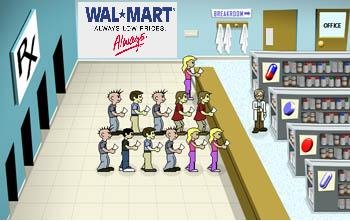
Wal-Mart spread the "$4 a Rx" good news
Wal-Mart Stores Inc. is expanding a programme offering $4 prescriptions for some generic drugs to 14 more states, just two weeks after rolling out the low-cost programme in Florida.
Analysts said the main benefit for Wal-Mart is in drawing more shoppers into its stores who may come for prescriptions and then stay to buy in other departments.
"It must be working for them. They must be seeing a benefit if they're expanding this rapidly," said Richard D. Hastings, senior retail analyst with Bernard Sands LLC.
More from the WaPo
Analysts said the main benefit for Wal-Mart is in drawing more shoppers into its stores who may come for prescriptions and then stay to buy in other departments.
"It must be working for them. They must be seeing a benefit if they're expanding this rapidly," said Richard D. Hastings, senior retail analyst with Bernard Sands LLC.
More from the WaPo
J&J - Natrecor: sales "tuneup"
The heart-failure drug Natrecor seemed sure to become a blockbuster after Scios put it on the market in 2001.
Besides its use in hospitalized patients, many clinics began giving it to walk-in patients in weekly sessions dubbed "tuneups.''
Some people -- including prominent heart specialist Dr. Eric Topol -- say Scios encouraged this with a hotline and brochure explaining how to bill Medicare for the sessions.
There was only one problem: Some medical experts contend Natrecor was never approved for such tuneups. Some also say it may not be as safe as initially thought.
Scios says studies show the drug is safe. And it has launched a campaign to clarify to doctors that the drug is not recommended for repeated use in patients in a clinic setting.
Nevertheless, the drug's sales have sagged and the company is under investigation by the U.S. attorney in San Francisco for allegedly engaging in "off-label'' marketing, promoting drugs for uses not approved by the government.
Since this case came to light, critics in two major medical journals have cited Natrecor as an example of how easy it is for drug companies to peddle their medicines for unapproved purposes.
Although doctors are allowed to prescribe drugs for off-label treatments, companies are forbidden from promoting their drugs for such uses.
More
Besides its use in hospitalized patients, many clinics began giving it to walk-in patients in weekly sessions dubbed "tuneups.''
Some people -- including prominent heart specialist Dr. Eric Topol -- say Scios encouraged this with a hotline and brochure explaining how to bill Medicare for the sessions.
There was only one problem: Some medical experts contend Natrecor was never approved for such tuneups. Some also say it may not be as safe as initially thought.
Scios says studies show the drug is safe. And it has launched a campaign to clarify to doctors that the drug is not recommended for repeated use in patients in a clinic setting.
Nevertheless, the drug's sales have sagged and the company is under investigation by the U.S. attorney in San Francisco for allegedly engaging in "off-label'' marketing, promoting drugs for uses not approved by the government.
Since this case came to light, critics in two major medical journals have cited Natrecor as an example of how easy it is for drug companies to peddle their medicines for unapproved purposes.
Although doctors are allowed to prescribe drugs for off-label treatments, companies are forbidden from promoting their drugs for such uses.
More
Introducing "The Pharm Side"

An artist who wishes to only be known as "The Pharm Side" has sent in some illustrations. They comment on the news covered by PharmaGossip.
Enjoy.
Sunday, October 22, 2006
Fat Wars - who to believe?
A report released by the Center for Consumer Freedom (CCF) titled An Epidemic of Obesity Myths uncovers the complicated web of funding and support between weight loss and pharmaceutical industries and the Obesity Society (formerly the North American Association for the Study of Obesity (NAASO)).
CCF's Senior Research Analyst J. Justin Wilson commented, "Our report exposes this effort by the $46 billion weight-loss industry to quietly nurture overblown rhetoric in an effort to panic the public about carrying a few extra pounds and force Medicare and HMOs to cover the cost of their drugs and programs. Pharmaceutical and weight-loss companies have invested millions of dollars in institutes, researchers, and studies -- all squarely aimed at hyping the ills of being overweight."
Today, as the Obesity Society commences their annual scientific meeting in Boston, CCF reminds journalists, scientists and anyone who buys into the worst of the "obesity epidemic" rhetoric, that much of the research put out by Obesity Society faculty has hyped the problem far beyond what's appropriate in dispassionate scientific discourse.
It is, also, perhaps no coincidence that F. Xavier Pi-Sunyer is set to receive the George A. Bray Founders Award for "significant contributions" to the NAASO and the Obesity Society, considering that both Bray and Pi-Sunyer have received significant financial support from leading weight loss companies. Both are profiled in CCF's report.
Past NAASO president Barbara Rolls acknowledged that "most of our donations come from a number of pharmaceutical companies."
In 1996, a NAASO newsletter noted that its Corporate Advisory Board consisted of representatives from contributing companies: Amgen, Eli Lilly, Roche, Interneuron, Knoll, Procter & Gamble Co., Slim-Fast Foods, and Wyeth-Ayerst Laboratories.
But.
The Center for Consumer Freedom is a nonprofit coalition supported by restaurants, food companies, and consumers, working together to promote personal responsibility and protect consumer choices.
Center for Consumer Freedom http://www.consumerfreedom.com/
CCF's Senior Research Analyst J. Justin Wilson commented, "Our report exposes this effort by the $46 billion weight-loss industry to quietly nurture overblown rhetoric in an effort to panic the public about carrying a few extra pounds and force Medicare and HMOs to cover the cost of their drugs and programs. Pharmaceutical and weight-loss companies have invested millions of dollars in institutes, researchers, and studies -- all squarely aimed at hyping the ills of being overweight."
Today, as the Obesity Society commences their annual scientific meeting in Boston, CCF reminds journalists, scientists and anyone who buys into the worst of the "obesity epidemic" rhetoric, that much of the research put out by Obesity Society faculty has hyped the problem far beyond what's appropriate in dispassionate scientific discourse.
It is, also, perhaps no coincidence that F. Xavier Pi-Sunyer is set to receive the George A. Bray Founders Award for "significant contributions" to the NAASO and the Obesity Society, considering that both Bray and Pi-Sunyer have received significant financial support from leading weight loss companies. Both are profiled in CCF's report.
Past NAASO president Barbara Rolls acknowledged that "most of our donations come from a number of pharmaceutical companies."
In 1996, a NAASO newsletter noted that its Corporate Advisory Board consisted of representatives from contributing companies: Amgen, Eli Lilly, Roche, Interneuron, Knoll, Procter & Gamble Co., Slim-Fast Foods, and Wyeth-Ayerst Laboratories.
But.
The Center for Consumer Freedom is a nonprofit coalition supported by restaurants, food companies, and consumers, working together to promote personal responsibility and protect consumer choices.
Center for Consumer Freedom http://www.consumerfreedom.com/
Saturday, October 21, 2006
Pfizer - Exubera: more US delays
Pfizer is delaying distribution of Exubera, its highly touted, FDA-approved inhaled insulin, until January over concerns about its effect on the lungs.
Seeking Alpha
Seeking Alpha
Friday, October 20, 2006
Bochox - just in time for Christmas
 Forget Botox. Chocolate is the best medicine!
I know its too early for Christmas. But this was just too good to miss.
Three bars for $19!
Hat tip: bookofjoe

Amgen and Roche "blood feud" continues
 Back story here.
Amgen on Friday said that a federal court has denied Roche's motion to dismiss Amgen's patent infringement lawsuit against Roche.
The court also denied a motion by Ortho Biotech Products L.P. to intervene as a co-plaintiff in the case, the Thousand Oaks, California-based biotechnology company said.
Amgen said it continues to believe that Roche's peg-EPO product violates Amgen's patents, and doesn't provide any clinical or patient benefit over Amgen's innovative therapies, Epogen and Aranesp.
Pfizer Unichem - OFT take a sniff at the deal
Plans by Pfizer to distribute its medicines in Britain exclusively through one supplier are being looked into by the consumer affairs watchdog to see if they raise competition concerns.
The Office of Fair Trading (OFT) said on Friday it was taking the step following complaints from independent pharmacies and wholesalers over an exclusive deal between Pfizer, the world’s top drugmaker, and Britain’s Alliance Boots Plc (through their UniChem wholesale arm).
"The OFT has a number of complaints expressing concern about Pfizer’s decision to distribute its products directly to customers using Alliance Boots from March next year," an OFT spokesman said.
"We are considering whether Pfizer’s action raises competition concerns and if this is something which the OFT should investigate further."
Critics believe Pfizer’s real aim for this move is to fight parallel trade, the legal practice in Europe whereby medicines are imported for resale into places like Britain from countries in southern Europe, where prices are lower.
Source: Reuters
The Office of Fair Trading (OFT) said on Friday it was taking the step following complaints from independent pharmacies and wholesalers over an exclusive deal between Pfizer, the world’s top drugmaker, and Britain’s Alliance Boots Plc (through their UniChem wholesale arm).
"The OFT has a number of complaints expressing concern about Pfizer’s decision to distribute its products directly to customers using Alliance Boots from March next year," an OFT spokesman said.
"We are considering whether Pfizer’s action raises competition concerns and if this is something which the OFT should investigate further."
Critics believe Pfizer’s real aim for this move is to fight parallel trade, the legal practice in Europe whereby medicines are imported for resale into places like Britain from countries in southern Europe, where prices are lower.
Source: Reuters
Bond bloopers
Insider loves the Bond movie series. Clearly others love to spot the continuity errors!
Merck - now the Canadian taxman wants $2 billion
Poor Merck.
Hot on the heels of the US IRS's $2.3 billion demand for the Bermuda Triangle/Project Ryland schmozzl comes this:
Revenue Canada is seeking $2 billion in unpaid taxes from pharmaceutical giant Merck Frosst, but Merck says the assessment is "without merit."
The Montreal newspaper La Presse reported yesterday that the federal department sent a notice to the company this month seeking taxes on a portion of the global profits from its popular drug Singulair, an asthma treatment that was developed in Montreal. The claim covers taxes for 1998 to 2004.
Merck says it transferred a part of its profits from the drug to Barbados.
The assessment is based on a tax rate of 22 per cent and includes interest and a penalty.
Source
Looks like Merck's tax advisers may have to earn their fees!
Hot on the heels of the US IRS's $2.3 billion demand for the Bermuda Triangle/Project Ryland schmozzl comes this:
Revenue Canada is seeking $2 billion in unpaid taxes from pharmaceutical giant Merck Frosst, but Merck says the assessment is "without merit."
The Montreal newspaper La Presse reported yesterday that the federal department sent a notice to the company this month seeking taxes on a portion of the global profits from its popular drug Singulair, an asthma treatment that was developed in Montreal. The claim covers taxes for 1998 to 2004.
Merck says it transferred a part of its profits from the drug to Barbados.
The assessment is based on a tax rate of 22 per cent and includes interest and a penalty.
Source
Looks like Merck's tax advisers may have to earn their fees!
Lilly - Xigris: sepsis sceptic blows the whistle
Lilly used questionable marketing practices to promote its drug to fight blood infections, according to several doctors. A whistleblower report in the New England Journal of Medicine accuses the company of initiating false reports of a shortage of the drug, Xigris.
The plan involved a public-relations firm hired by Eli Lilly, which then spread the word that its very expensive drug was being "rationed," the report says. It also included descriptions of physicians being "systematically forced" to decide who would live and who would die.
Xigris was designed to fight sepsis, a condition that kills more than 200,000 Americans annually. It is the only approved drug for sepsis, and it costs $8,000 to treat a single patient. Lilly hoped it would be a blockbuster, with sales of at least a billion dollars a year. But after five years on the market, sales are only $200 million.
That led the company to take unusual steps, according to Dr. Robert Danner, an infectious-disease expert at the National Institutes of Health. Danner emphasizes that in this case, he is speaking as a private citizen, not an NIH employee.
Danner says Lilly hired a P.R. firm that created the message that doctors were being forced to ration Xigris because of its high cost. That message was promoted by a newly formed task force on ethics. Lilly funded the task force with $2 million.
Next, a group of physicians, many with financial ties to Lilly, founded the Surviving Sepsis Campaign. Lilly provided the great majority of the funding. The campaign's first task was to formulate new practice guidelines for treating sepsis.
At least 11 medical groups endorsed the new guidelines. But the influential Infectious Diseases Society of America did not.
Dr. Naomi O'Grady chaired the panel of the Infectious Diseases Society that reviewed the guidelines.
"Let me choose my words carefully," said O'Grady, who is not involved with the current report. "This guideline really, I believe, was designed to promote a product."
O'Grady says her panel felt the guideline was developed hastily, and did not properly weigh the evidence for Xigris. The committee also didn't like the fact that Lilly funded the process.
Eli Lilly spokeswoman Judy Kay Moore insists that the company did not mastermind the ethics task force or steer the guideline-writing process.
And it was only a coincidence, Moore says, that the ethics task force and the Surviving Sepsis Campaign used the same P.R. firm, Belsito and Company.
We did not intend for or direct Belsito and Company to act on Lilly's behalf in this regard," Moore says. "Lilly did not recommend that they hire Belsito. And Lilly gave a grant to these groups and off they went to do their work."
But Lilly says that it is taking the criticism "very seriously."
Dr. Mitchell Levy, of Rhode Island Hospital, is a leader in the Surviving Sepsis Campaign. He says there's nothing wrong with a drug company funding the efforts, as long as everybody's open about it.
"In an ideal world, where there was enough NIH funding," Levy says, "for purity it would be great to not have to use industry funding."
Levy is working with a respected Massachusetts firm, the Institute for Healthcare Improvement, to turn the complex treatment guidelines into a boiled-down version that hospitals pledge to implement.
Many believe the guidelines set the stage for how doctors ultimately will be paid -- that is, according to whether they adhere to treatment guidelines. Robert Danner, one of Eli Lilly's critics, says this gives drug companies an even greater motive to influence guideline-writing.
Source: NPR
The plan involved a public-relations firm hired by Eli Lilly, which then spread the word that its very expensive drug was being "rationed," the report says. It also included descriptions of physicians being "systematically forced" to decide who would live and who would die.
Xigris was designed to fight sepsis, a condition that kills more than 200,000 Americans annually. It is the only approved drug for sepsis, and it costs $8,000 to treat a single patient. Lilly hoped it would be a blockbuster, with sales of at least a billion dollars a year. But after five years on the market, sales are only $200 million.
That led the company to take unusual steps, according to Dr. Robert Danner, an infectious-disease expert at the National Institutes of Health. Danner emphasizes that in this case, he is speaking as a private citizen, not an NIH employee.
Danner says Lilly hired a P.R. firm that created the message that doctors were being forced to ration Xigris because of its high cost. That message was promoted by a newly formed task force on ethics. Lilly funded the task force with $2 million.
Next, a group of physicians, many with financial ties to Lilly, founded the Surviving Sepsis Campaign. Lilly provided the great majority of the funding. The campaign's first task was to formulate new practice guidelines for treating sepsis.
At least 11 medical groups endorsed the new guidelines. But the influential Infectious Diseases Society of America did not.
Dr. Naomi O'Grady chaired the panel of the Infectious Diseases Society that reviewed the guidelines.
"Let me choose my words carefully," said O'Grady, who is not involved with the current report. "This guideline really, I believe, was designed to promote a product."
O'Grady says her panel felt the guideline was developed hastily, and did not properly weigh the evidence for Xigris. The committee also didn't like the fact that Lilly funded the process.
Eli Lilly spokeswoman Judy Kay Moore insists that the company did not mastermind the ethics task force or steer the guideline-writing process.
And it was only a coincidence, Moore says, that the ethics task force and the Surviving Sepsis Campaign used the same P.R. firm, Belsito and Company.
We did not intend for or direct Belsito and Company to act on Lilly's behalf in this regard," Moore says. "Lilly did not recommend that they hire Belsito. And Lilly gave a grant to these groups and off they went to do their work."
But Lilly says that it is taking the criticism "very seriously."
Dr. Mitchell Levy, of Rhode Island Hospital, is a leader in the Surviving Sepsis Campaign. He says there's nothing wrong with a drug company funding the efforts, as long as everybody's open about it.
"In an ideal world, where there was enough NIH funding," Levy says, "for purity it would be great to not have to use industry funding."
Levy is working with a respected Massachusetts firm, the Institute for Healthcare Improvement, to turn the complex treatment guidelines into a boiled-down version that hospitals pledge to implement.
Many believe the guidelines set the stage for how doctors ultimately will be paid -- that is, according to whether they adhere to treatment guidelines. Robert Danner, one of Eli Lilly's critics, says this gives drug companies an even greater motive to influence guideline-writing.
Source: NPR
Thursday, October 19, 2006

Diana Chiafair - Miss FHM candidate and drug rep

"Appearing in FHM has definitely helped me in my work as a rep for a pharmaceuticals company.
Usually you have to push your way into doctors' offices to see them; now it's like, 'Oh, the FHM girl is here.'
And I go right on in.
All the doctors and nurses out there read FHM. They've all seen me in lingerie—and I bet they think about what I'm wearing under my uniform when I visit them."
Go here and see more of Diana for yourselves!
Hat Tip: Old School Rep
German G-BA says "Nein!" to Acomplia and Exubera
The German state health insurance system will not reimburse the cost of treatment with Sanofi-Aventis' new obesity drug Acomplia or Exubera an inhaled formulation of insulin developed by Pfizer, it emerged yesterday.
The Federal Joint Committee charged with recommending drug prescribing practices and reimbursement in Germany, the G-BA, believes funding treatment with Acomplia (rimonabant) is inappropriate because it is a lifestyle drug, a viewpoint which Sanofi-Aventis has been quick to contest.
Acomplia was first introduced in June in some European markets after its approval for use alongside diet and exercise in treating overweight or obese patients with signs of dyslipidaemia and other associated risk factors. Sanofi-Aventis believes it has a blockbuster on its hands with the drug, although much will depend on securing approval in the USA, which could come before the end of the year.
Sanofi insists Acomplia meets a pressing need, with the number of obese people spiralling upwards around the developed world, closely shadowed by increases in healthcare costs. The drug's monthly cost of around $100 is justified by the improvement in cardiometabolic risk factors, it says.
Meanwhile, the G-BA also concluded that the increased cost of Exubera compared to injectable insulins did not outweigh its benefits, as its efficacy was the same but it cost five times as much.
This view echoes that of the UK's National Institute of Health and Clinical Excellence, which recommended earlier this year that Exubera only be used in patients with demonstrated needle phobia
Source: PharmaTimes
Insider's view: an interesting turn of events.
Welcome to the real world Big Pharma!
The Acomplia situation might explain why Big Pharma has been so involved in "medicalizing" obesity as "metabolic syndrome".
The Federal Joint Committee charged with recommending drug prescribing practices and reimbursement in Germany, the G-BA, believes funding treatment with Acomplia (rimonabant) is inappropriate because it is a lifestyle drug, a viewpoint which Sanofi-Aventis has been quick to contest.
Acomplia was first introduced in June in some European markets after its approval for use alongside diet and exercise in treating overweight or obese patients with signs of dyslipidaemia and other associated risk factors. Sanofi-Aventis believes it has a blockbuster on its hands with the drug, although much will depend on securing approval in the USA, which could come before the end of the year.
Sanofi insists Acomplia meets a pressing need, with the number of obese people spiralling upwards around the developed world, closely shadowed by increases in healthcare costs. The drug's monthly cost of around $100 is justified by the improvement in cardiometabolic risk factors, it says.
Meanwhile, the G-BA also concluded that the increased cost of Exubera compared to injectable insulins did not outweigh its benefits, as its efficacy was the same but it cost five times as much.
This view echoes that of the UK's National Institute of Health and Clinical Excellence, which recommended earlier this year that Exubera only be used in patients with demonstrated needle phobia
Source: PharmaTimes
Insider's view: an interesting turn of events.
Welcome to the real world Big Pharma!
The Acomplia situation might explain why Big Pharma has been so involved in "medicalizing" obesity as "metabolic syndrome".
Bayer Schering merger - Merry Christmas you're fired!
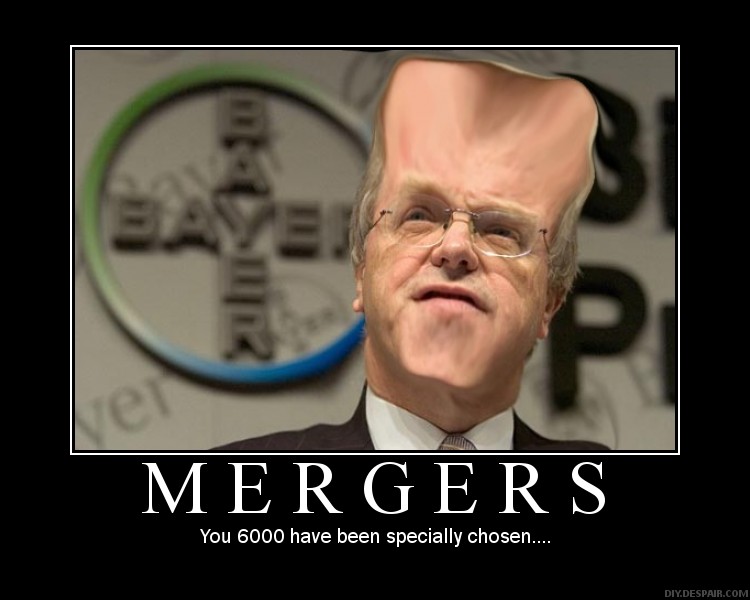
Bayer Schering Pharma's head of the works' council said the future shape of the merged company should be clearer at the end of the year giving a better idea of the final number of positions.
Bayer CEO Werner Wenning (Halloween pic) had earlier said that 6,000 positions could be terminated through the integration of Bayer and Schering.
Wenning said the cuts will be handled in a 'socially responsible manner.'
The works council has demanded however that the cuts be lessened. 'We will fight for every last position,' their leader has said.
Cholesterol - time to stop moving the goalposts?
The Annals of Internal Medicine has published a paper reviewing the available evidence to support the currently proposed treatment goals for lipid levels.
Treatment goals for total cholesterol and low-density lipoprotein have been lowered in recent years in America and the United Kingdom. Despite these reductions in the targets the authors of this review found no high-quality evidence to support the targets. They also conclude that there is no reason that evidence could not be produced very quickly from a cohort analysis of large clinical trials such as the Heart Protection Study (HPS).
Aggressively pursuing lower lipid targets is not supported by high quality evidence at this time.
In the first instance clinicians should ensure that patients are prescribed a cost-effective statin as per previous recommendations.
Hat tip: Prescribing Advice for GPs
Treatment goals for total cholesterol and low-density lipoprotein have been lowered in recent years in America and the United Kingdom. Despite these reductions in the targets the authors of this review found no high-quality evidence to support the targets. They also conclude that there is no reason that evidence could not be produced very quickly from a cohort analysis of large clinical trials such as the Heart Protection Study (HPS).
Aggressively pursuing lower lipid targets is not supported by high quality evidence at this time.
In the first instance clinicians should ensure that patients are prescribed a cost-effective statin as per previous recommendations.
Hat tip: Prescribing Advice for GPs
Is the end of drug samples nigh?
A new study to be published in the October issue of Journal of Medical Ethics reports that one in three US physicians believes getting free drug samples from pharmaceutical companies affects doctors’ decisions about which medicines to prescribe to their patients.
Among 217 US obstetricians and gynecologists surveyed for the study, 92% said getting samples was ethically acceptable, but a third acknowledged that the handouts might influence their drug choice.
Participating physicians tended to believe, however, that free samples were likely to have more influence on other doctors than on their own prescribing habits.
According to the study conducted by a research team at the American College of Obstetricians and Gynecologists, drug samples are the fastest-growing form of marketing by drug companies.
The value of free samples reached $16 billion, or 63%, of the $25.3 billion the industry spent in the US to market their products in 2003.
“Fewer than two-thirds of our respondents indicated that they distributed free samples on the basis of their knowledge of the drug’s effectiveness,” the study says.
Doctors in the study said they mostly handed out samples based on patients’ perceived financial need. Others said they distributed samples because they were available and convenient for patients.
The study’s authors recommend discontinuing free samples and other gifts from drug makers.
“The only way to exclude bias is to do away with incentive items entirely, because bias remains even when people are taught about bias,” the study’s authors say.
Among 217 US obstetricians and gynecologists surveyed for the study, 92% said getting samples was ethically acceptable, but a third acknowledged that the handouts might influence their drug choice.
Participating physicians tended to believe, however, that free samples were likely to have more influence on other doctors than on their own prescribing habits.
According to the study conducted by a research team at the American College of Obstetricians and Gynecologists, drug samples are the fastest-growing form of marketing by drug companies.
The value of free samples reached $16 billion, or 63%, of the $25.3 billion the industry spent in the US to market their products in 2003.
“Fewer than two-thirds of our respondents indicated that they distributed free samples on the basis of their knowledge of the drug’s effectiveness,” the study says.
Doctors in the study said they mostly handed out samples based on patients’ perceived financial need. Others said they distributed samples because they were available and convenient for patients.
The study’s authors recommend discontinuing free samples and other gifts from drug makers.
“The only way to exclude bias is to do away with incentive items entirely, because bias remains even when people are taught about bias,” the study’s authors say.
Wednesday, October 18, 2006
Bayer - Trasylol: vee haf vays of making you tok
Bayer is in hot water after admitting that it failed to tell US regulators about a study linking its heart-surgery drug, Trasylol, to deadly side effects because two senior employees did not inform supervisors that the report had been completed.
The German firm said it had appointed an independent investigator to find out exactly why preliminary results from the observational trial on Trasylol were not made known to a US Food and Drug Administration (FDA) advisory committee before it met to assess the safety of the drug on September 21.
The FDA began reviewing Trasylol earlier this year after two earlier studies published in medical journals linked its use to kidney problems. One of the studies also found that the drug could increase the risk of heart attacks and strokes.
After the September 21 meeting, the FDA advisory committee affirmed that Trasylol was safe and effective for patients undergoing coronary artery bypass graft surgery. It was not until a week later that Bayer released the results of the 67,000-patient study, which confirmed the earlier trial linking usage of the drug to an increased risk of kidney failure, heart attacks and strokes.
Bayer's general counsel, Dr Roland Hartwig, said Bayer acknowledged and regretted the error it made in not sharing the information with the FDA before the meeting.
“Based on our investigation so far, we believe this was a serious error in judgment by two individuals,” he added.
Bayer said it had suspended the two employees with immediate effect while former White House counsel, Fred Fielding, from the law firm Wiley Rein & Fielding, investigates the lapse. It also said it expects that a “specific corrective action plan” may arise from the independent investigation, adding that it is “determined to take all appropriate steps to ensure that something like this does not happen again”.
Bayer spokeswoman Staci Gouveia said Bayer believes that the two employees, who work in the company's global drug safety group in Germany, were the only company officials who knew the study had been finished. They did not disclose the report because they viewed it as preliminary and had “significant” concerns about the methodology, she added.
The employees received the report on September 14 from i3 Drug Safety, a private clinical research company, and completed a list of questions for the study's authors.
Sidney Wolfe, of the public interest watchdog group, Public Citizen, said Bayer may have violated the law by failing to release the results.
“The thing that's most concerning to me is the withholding of data is a criminal offence,” he said in an interview before Bayer announced the investigation. “They can say it's a mistake all they want, but it's a fairly big time mistake to make.”
One member of the FDA advisory committee, Steven Findlay, a Consumers Union healthcare analyst, said he doubted whether knowledge of the study's completion was limited to just two Bayer employees.
“It just strains credulity that only they would know,” he said.
The findings from the independent investigation will be published when it is completed.
Source: Pharma Marketing
The German firm said it had appointed an independent investigator to find out exactly why preliminary results from the observational trial on Trasylol were not made known to a US Food and Drug Administration (FDA) advisory committee before it met to assess the safety of the drug on September 21.
The FDA began reviewing Trasylol earlier this year after two earlier studies published in medical journals linked its use to kidney problems. One of the studies also found that the drug could increase the risk of heart attacks and strokes.
After the September 21 meeting, the FDA advisory committee affirmed that Trasylol was safe and effective for patients undergoing coronary artery bypass graft surgery. It was not until a week later that Bayer released the results of the 67,000-patient study, which confirmed the earlier trial linking usage of the drug to an increased risk of kidney failure, heart attacks and strokes.
Bayer's general counsel, Dr Roland Hartwig, said Bayer acknowledged and regretted the error it made in not sharing the information with the FDA before the meeting.
“Based on our investigation so far, we believe this was a serious error in judgment by two individuals,” he added.
Bayer said it had suspended the two employees with immediate effect while former White House counsel, Fred Fielding, from the law firm Wiley Rein & Fielding, investigates the lapse. It also said it expects that a “specific corrective action plan” may arise from the independent investigation, adding that it is “determined to take all appropriate steps to ensure that something like this does not happen again”.
Bayer spokeswoman Staci Gouveia said Bayer believes that the two employees, who work in the company's global drug safety group in Germany, were the only company officials who knew the study had been finished. They did not disclose the report because they viewed it as preliminary and had “significant” concerns about the methodology, she added.
The employees received the report on September 14 from i3 Drug Safety, a private clinical research company, and completed a list of questions for the study's authors.
Sidney Wolfe, of the public interest watchdog group, Public Citizen, said Bayer may have violated the law by failing to release the results.
“The thing that's most concerning to me is the withholding of data is a criminal offence,” he said in an interview before Bayer announced the investigation. “They can say it's a mistake all they want, but it's a fairly big time mistake to make.”
One member of the FDA advisory committee, Steven Findlay, a Consumers Union healthcare analyst, said he doubted whether knowledge of the study's completion was limited to just two Bayer employees.
“It just strains credulity that only they would know,” he said.
The findings from the independent investigation will be published when it is completed.
Source: Pharma Marketing
How quickly can you find the man's head?

Take a close look and find the man's head.
Can you find the man within 3 seconds? If you can find the Man's Head within 3 seconds, your right brain is more developed than normal people.
If you can find the Man's Head within 1 minute, your right brain is developed normally.
If you find the Man's Head within 1-3 minutes, your right brain's a disaster!
Allegidly!

"Subconscious programming" - just say NO!
As the medical industry is reassessing how physicians should disclose the shares of stock and other compensation they receive from health-care companies, another ethical question has sparked a wave of hand-wringing at academic medical centers across the U.S.
Can a gift as seemingly worthless as a pen or a slice of pizza influence how doctors do their jobs?
So far, the consensus answer seems to be yes.
Some experts fear that if a pharma sales representative feeds a physician while describing a new drug to him, or leaves behind pens sporting the drug's name, that doctor may be more apt to prescribe the drug, even if the decision is subconscious.
"Most doctors tell me they aren't influenced by gifts, and I think they believe that," says Dr. David Korn, a senior vice-president at the Association of American Medical Colleges in Washington. "But there are real neuropsychological changes that occur when you get a gift, even a ballpoint pen, for God's sake."
More at Businessweek
Can a gift as seemingly worthless as a pen or a slice of pizza influence how doctors do their jobs?
So far, the consensus answer seems to be yes.
Some experts fear that if a pharma sales representative feeds a physician while describing a new drug to him, or leaves behind pens sporting the drug's name, that doctor may be more apt to prescribe the drug, even if the decision is subconscious.
"Most doctors tell me they aren't influenced by gifts, and I think they believe that," says Dr. David Korn, a senior vice-president at the Association of American Medical Colleges in Washington. "But there are real neuropsychological changes that occur when you get a gift, even a ballpoint pen, for God's sake."
More at Businessweek
Merck - Vioxx: check please
A New Jersey judge yesterday ordered Merck to release records on how much it spent on a trial involving its Vioxx painkiller.
The information would provide a window into how much Merck spends on its trials, and what its legal defense costs could be in the future. Nearly 30,000 suits have been filed against Merck, which has vowed to try each case involving Vioxx.
So far, Merck has reserved $970 million for legal costs and spent $285 million of that last year.
Judge Carol Higbee's order stems from a request from plaintiffs' lawyers that Merck pay their legal fees and expenses of roughly $5.6 million for a trial that combined the cases of two men who suffered heart attacks while taking Vioxx.
The jury found Merck committed consumer fraud in its marketing of Vioxx, and that finding allows plaintiffs' firms to ask for legal fees.
But Merck balked at the expense level, prompting plaintiffs' lawyers to ask how much Merck spent on the trial.
Star-Ledger
The information would provide a window into how much Merck spends on its trials, and what its legal defense costs could be in the future. Nearly 30,000 suits have been filed against Merck, which has vowed to try each case involving Vioxx.
So far, Merck has reserved $970 million for legal costs and spent $285 million of that last year.
Judge Carol Higbee's order stems from a request from plaintiffs' lawyers that Merck pay their legal fees and expenses of roughly $5.6 million for a trial that combined the cases of two men who suffered heart attacks while taking Vioxx.
The jury found Merck committed consumer fraud in its marketing of Vioxx, and that finding allows plaintiffs' firms to ask for legal fees.
But Merck balked at the expense level, prompting plaintiffs' lawyers to ask how much Merck spent on the trial.
Star-Ledger
Organon - asenapine delay due to "mixed results"
Akzo Nobel NV, the Dutch chemicals and pharmaceuticals maker, surprised investors by saying it may have to delay release of a new drug to treat schizophrenia after getting mixed results in a key trial.
Chief Executive Hans Wijers told journalists in a conference call the company expects results from its phase III trial of the drug asenapine within several weeks.
A phase III trial tests a drug already generally thought to be safe on a large group of people to see whether there are any long-term negative health effects before it goes to market.
Wijers said the company will discuss the results with the U.S. Food and Drug Administration. He said he still expects the drug to "play an important role" in the company's pharmaceutical division Organon, which Akzo plans to spin off next year.
"In our view, this is worrisome news," said analyst Geert-Jan Hoppers of the Dutch investment bank F. Van Lanschot Bankiers. "Most of the value we attribute to Organon's pipeline relates to asenapine."
Source
Chief Executive Hans Wijers told journalists in a conference call the company expects results from its phase III trial of the drug asenapine within several weeks.
A phase III trial tests a drug already generally thought to be safe on a large group of people to see whether there are any long-term negative health effects before it goes to market.
Wijers said the company will discuss the results with the U.S. Food and Drug Administration. He said he still expects the drug to "play an important role" in the company's pharmaceutical division Organon, which Akzo plans to spin off next year.
"In our view, this is worrisome news," said analyst Geert-Jan Hoppers of the Dutch investment bank F. Van Lanschot Bankiers. "Most of the value we attribute to Organon's pipeline relates to asenapine."
Source
Disease Mongering - Big ole Metabolic Syndrome
Does Metabolic Syndrome exist?
Skeptics, which include the American Diabetes Association, suggest that researchers, physicians, and pharmaceutical companies have been so hasty to embrace the disease (each for their own reasons), they've overlooked evidence that the science behind the diagnosis is flimsy and conjectural. These critics say that so-called metabolic syndrome lumps together risks we already recognize and monitor – or worse, that it's just a fancy way to describe obesity. By accepting it, we medicalize a lifestyle condition that we already know how to treat: with diet and exercise.
The debate is hardly academic. The pharmaceutical industry has spent millions of dollars developing dozens of drugs aimed at obesity generally and metabolic syndrome in particular. Many of those drugs are now or will soon be submitted to the Food and Drug Administration for approval. At the same time, the industry is lobbying the FDA to recognize the syndrome as a disease and to reconsider its approach to obesity drugs, a shift that would accelerate demand for new drugs.
Much more here. It's an excellent read.
Hat tip: Steve at Impactiviti
Skeptics, which include the American Diabetes Association, suggest that researchers, physicians, and pharmaceutical companies have been so hasty to embrace the disease (each for their own reasons), they've overlooked evidence that the science behind the diagnosis is flimsy and conjectural. These critics say that so-called metabolic syndrome lumps together risks we already recognize and monitor – or worse, that it's just a fancy way to describe obesity. By accepting it, we medicalize a lifestyle condition that we already know how to treat: with diet and exercise.
The debate is hardly academic. The pharmaceutical industry has spent millions of dollars developing dozens of drugs aimed at obesity generally and metabolic syndrome in particular. Many of those drugs are now or will soon be submitted to the Food and Drug Administration for approval. At the same time, the industry is lobbying the FDA to recognize the syndrome as a disease and to reconsider its approach to obesity drugs, a shift that would accelerate demand for new drugs.
Much more here. It's an excellent read.
Hat tip: Steve at Impactiviti
Side Effects - the book after the movie

LOS ANGELES, CA (PRWEB) October 17, 2006 -– The pharmaceutical industry spent 4.5 billion dollars on direct-to-consumer advertising in 2005, and spending for the first half of 2006 rose another 9 percent, according to TNS Media Intelligence.
On the heels of this newly-released information, one former pharmaceutical industry insider is raising awareness about the influential messages bombarding consumers and other deceptive marketing tactics used by Big Pharma in her new book, Side Effects.
After two successful films exposing the profiteering tactics of the pharmaceutical industry, filmmaker Kathleen Slattery-Moschkau has packaged her screenplays into an important book that serves as a critical resource guide. Side Effects will have consumers, doctors and professors across the country asking critical questions about the ethics and motives behind the drug companies’ television and print ad campaigns.
Intended for use in classrooms, at book club meetings or for any lively discussion, Side Effects frames the issues within the pharmaceutical industry in a point-counterpoint format, and provides readers with information on where to find bias-free information about prescription drugs and health in general.
On the heels of this newly-released information, one former pharmaceutical industry insider is raising awareness about the influential messages bombarding consumers and other deceptive marketing tactics used by Big Pharma in her new book, Side Effects.
After two successful films exposing the profiteering tactics of the pharmaceutical industry, filmmaker Kathleen Slattery-Moschkau has packaged her screenplays into an important book that serves as a critical resource guide. Side Effects will have consumers, doctors and professors across the country asking critical questions about the ethics and motives behind the drug companies’ television and print ad campaigns.
Intended for use in classrooms, at book club meetings or for any lively discussion, Side Effects frames the issues within the pharmaceutical industry in a point-counterpoint format, and provides readers with information on where to find bias-free information about prescription drugs and health in general.
The book also includes the screenplays for both of Slattery-Moschkau’s films, Side Effects and Money Talks: Profit Before Patient Safety, which have received press attention from around the world for exposing the dangerous tactics the drug companies are engaging in at the expense of patients’ health.
“Readers and viewers of Slattery-Moschkau’s work will be forever changed in their perception of the pharmaceutical industry,” said Dr. Bradley Lewis of New York University’s Gallatin School of Individualized Study and Department of Psychiatry. “They will be better citizens—better prepared to help bring about legislation to curb the excess of an industry careening out of control.”
“This book is intended to provide content that is accessible, entertaining, and useful to everyone from consumers to current and future physicians,” said Slattery-Moschkau. “Our goal is to provide insight into the films and the subject matter as a whole, and to get people thinking and talking about the subject.”
Slattery-Mosckau’s writings are based on the decade she spent pushing pills for two of the largest pharmaceutical companies. She is an expert on the topic and provides an insider’s glimpse of one of the world’s most profitable industries.
“Readers and viewers of Slattery-Moschkau’s work will be forever changed in their perception of the pharmaceutical industry,” said Dr. Bradley Lewis of New York University’s Gallatin School of Individualized Study and Department of Psychiatry. “They will be better citizens—better prepared to help bring about legislation to curb the excess of an industry careening out of control.”
“This book is intended to provide content that is accessible, entertaining, and useful to everyone from consumers to current and future physicians,” said Slattery-Moschkau. “Our goal is to provide insight into the films and the subject matter as a whole, and to get people thinking and talking about the subject.”
Slattery-Mosckau’s writings are based on the decade she spent pushing pills for two of the largest pharmaceutical companies. She is an expert on the topic and provides an insider’s glimpse of one of the world’s most profitable industries.
For more information or to order the book, visit www.sideeffectsthemovie.com.
To arrange an interview with pharmaceutical insider Kathleen Slattery-Moschkau, contact Cari Reisinger of Hummingbird Pictures at (414) 263-1958.
To arrange an interview with pharmaceutical insider Kathleen Slattery-Moschkau, contact Cari Reisinger of Hummingbird Pictures at (414) 263-1958.
Tuesday, October 17, 2006
Biotech Bonanza contd. - Roche and InterMune
Shares of InterMune vaulted Tuesday after the company scored an exclusive collaboration agreement with Swiss giant Roche for hepatitis C drugs.
The companies said after the bell Monday that they plan to develop and commercialize products from InterMune's HCV protease inhibitor program. The Brisbane, Calif., biotech said it will get a $60 million upfront payment and up to $470 million in milestones, including $35 million in the next year.
The companies said after the bell Monday that they plan to develop and commercialize products from InterMune's HCV protease inhibitor program. The Brisbane, Calif., biotech said it will get a $60 million upfront payment and up to $470 million in milestones, including $35 million in the next year.

Lilly get it on with Icos
Lilly on Tuesday said it agreed to acquire Icos, its partner in the production and marketing of erectile-dysfunction drug Cialis, for about $2.1 billion.
Source
Source

Merck - Januvia: it's here
Merck announced today that the FDA approved JANUVIA™ (sitagliptin phosphate), the first DPP-4 inhibitor available in the United States for the treatment of type 2 diabetes.
Januvia has been approved as monotherapy and as add-on therapy to either of two other types of oral diabetes medications, metformin or thiazolidinediones (TZDs), to improve blood sugar (glucose) control in patients with type 2 diabetes when diet and exercise is not enough.
The recommended dose of Januvia is 100 mg once daily. Januvia should not be used in patients with type 1 diabetes or for the treatment of diabetic ketoacidosis, as it would not be effective in these settings.
Januvia has been approved as monotherapy and as add-on therapy to either of two other types of oral diabetes medications, metformin or thiazolidinediones (TZDs), to improve blood sugar (glucose) control in patients with type 2 diabetes when diet and exercise is not enough.
The recommended dose of Januvia is 100 mg once daily. Januvia should not be used in patients with type 1 diabetes or for the treatment of diabetic ketoacidosis, as it would not be effective in these settings.
NicOx - naproxcinod: too clever a move?
France's NicOx has circumvented what could have been a major obstacle en route to winning approval for its lead drug naproxcinod (HCT 3012) in Europe, after winning agreement from the regulatory authorities that a major, long-term cardiovascular safety study will not be required.
Ongoing debate about the cardiovascular safety of non-steroidal anti-inflammatory drugs (NSAIDs) - including naproxcinod's parent compound naproxen - has led to speculation that the European Medicines Agency might ask for a stringent safety study before giving a green light to NicOx' product.
Instead, the company has proposed a plan to create a pre-approval database, in accordance with guidelines drawn up by the joint regulator-industry International Conference on Harmonisation (ICH) project, which will look at data from the clinical trials programme for naproxcinod.
NicOx is conducting three Phase III trials of the drug in osteoarthritis of the hip and knee and, with the need for a long-term safety study taken out of the equation, remains on track to file for approval of the drug in early 2009.
In addition to the more general concerns about the risk of heart attacks and stroke with conventional NSAIDs - which have arisen on the back of the withdrawal of Merck & Co's COX-selective Vioxx (rofecoxib) from the market in 2004 - there is growing evidence that NSAIDs can cause elevations in blood pressure in susceptible individuals. Naproxen itself carries a warning on its label that it can impair the effects of blood pressure-lowering drugs.
Part of NicOx' Phase III programme for naproxcinod is designed to show it has no detrimental effect on blood pressure, and data will be collected prospectively from all Phase III trials to try to demonstrate that quality.
Source: PharmaTimes
Insider's view: Is this a good idea, given the reviews of NSAID's underway? Let's see.
Ongoing debate about the cardiovascular safety of non-steroidal anti-inflammatory drugs (NSAIDs) - including naproxcinod's parent compound naproxen - has led to speculation that the European Medicines Agency might ask for a stringent safety study before giving a green light to NicOx' product.
Instead, the company has proposed a plan to create a pre-approval database, in accordance with guidelines drawn up by the joint regulator-industry International Conference on Harmonisation (ICH) project, which will look at data from the clinical trials programme for naproxcinod.
NicOx is conducting three Phase III trials of the drug in osteoarthritis of the hip and knee and, with the need for a long-term safety study taken out of the equation, remains on track to file for approval of the drug in early 2009.
In addition to the more general concerns about the risk of heart attacks and stroke with conventional NSAIDs - which have arisen on the back of the withdrawal of Merck & Co's COX-selective Vioxx (rofecoxib) from the market in 2004 - there is growing evidence that NSAIDs can cause elevations in blood pressure in susceptible individuals. Naproxen itself carries a warning on its label that it can impair the effects of blood pressure-lowering drugs.
Part of NicOx' Phase III programme for naproxcinod is designed to show it has no detrimental effect on blood pressure, and data will be collected prospectively from all Phase III trials to try to demonstrate that quality.
Source: PharmaTimes
Insider's view: Is this a good idea, given the reviews of NSAID's underway? Let's see.
Forbes put Amgen in their crosshairs
In the red-ink-drenched biotechnology sector the success of Amgen takes on a fairy-tale quality.
This 26-year-old firm has scored several blockbuster drugs that boost blood-cell production in kidney dialysis and cancer patients. Last year it earned $3.7 billion on revenue of $12.4 billion. The 8,000 employees at its headquarters in Thousand Oaks, Calif. need a shuttle bus to traverse its 194-acre campus.
What's not to like about this happy story? Just three things.
One is that Amgen's patents are expiring, probably too fast for the company to make up the lost revenue with new inventions.
Next is that the firm's sharp-elbowed sales tactics could come back to haunt it. It uses leverage from a must-have drug to pressure doctors into also prescribing the Amgen product in a market where there is competition.
That strategy has precipitated an antitrust lawsuit by Johnson & Johnson (nyse: JNJ - news - people ) and has backfired at some medical practices whose M.D.s don't like feeling strong-armed.
The third problem is that a dispute is brewing about whether certain Amgen patients are getting more of one costly drug than they really need.
The drug in question is Epogen, which stimulates the body to produce red blood cells. Dosing levels have crept up by a factor of four over the past decade, though some doubt that this makes dialysis patients live longer. The higher doses have the side effect of fattening the bank accounts of both Amgen and the clinics that choose the prescriptions.
The insurers who pay the bills have taken notice. That group includes Medicare, which spent $1.75 billion on Epogen last year, more than on any other drug.
Read on.
This 26-year-old firm has scored several blockbuster drugs that boost blood-cell production in kidney dialysis and cancer patients. Last year it earned $3.7 billion on revenue of $12.4 billion. The 8,000 employees at its headquarters in Thousand Oaks, Calif. need a shuttle bus to traverse its 194-acre campus.
What's not to like about this happy story? Just three things.
One is that Amgen's patents are expiring, probably too fast for the company to make up the lost revenue with new inventions.
Next is that the firm's sharp-elbowed sales tactics could come back to haunt it. It uses leverage from a must-have drug to pressure doctors into also prescribing the Amgen product in a market where there is competition.
That strategy has precipitated an antitrust lawsuit by Johnson & Johnson (nyse: JNJ - news - people ) and has backfired at some medical practices whose M.D.s don't like feeling strong-armed.
The third problem is that a dispute is brewing about whether certain Amgen patients are getting more of one costly drug than they really need.
The drug in question is Epogen, which stimulates the body to produce red blood cells. Dosing levels have crept up by a factor of four over the past decade, though some doubt that this makes dialysis patients live longer. The higher doses have the side effect of fattening the bank accounts of both Amgen and the clinics that choose the prescriptions.
The insurers who pay the bills have taken notice. That group includes Medicare, which spent $1.75 billion on Epogen last year, more than on any other drug.
Read on.


PhRMA - doing the business in Washington
From The Lexington Herald-Leader :
The pharmaceutical industry needed a friendly senator in 1999, and it was willing to talk money.
Senate Democrats were pushing universal prescription drug coverage for senior citizens -- including a provision to let Medicare negotiate for cheaper prices. Drug companies wanted to stop them.
Barry Caldwell, lobbyist at the Pharmaceutical Research and Manufacturing Association (PhRMA), sent his boss a memo explaining that they would sit down with Sen. Mitch McConnell, R-Ky. McConnell had the ear of other GOP senators as chairman of the National Republican Senatorial Committee (NRSC), their fund-raising machine, Caldwell said.
Caldwell listed four objectives for their Feb. 9, 1999, meeting with McConnell.
'Personal introduction of you to him,' Caldwell wrote to Alan Holmer, the head of PhRMA in Washington.
'Apprising him of industry's concern with attention on pharmaceutical costs and efforts by Democrats to demagogue the issue at Republican expense,' he wrote. 'Sen. Ted Kennedy (D-Mass.) prepared to force Republicans to choose between a tax cut for the rich and a drug benefit for seniors.'
'Soliciting the senator's views on issue.'
'And,' he concluded, 'expressing PhRMA's willingness to be a resource, substantially and politically, to assist in maintaining a Republican majority in 2000.'
Caldwell referred to campaign money. To refresh his boss's memory, he attached a list of the pharmaceutical industry's Republican Party donations during the 1998 elections.
'Industry has been a solid supporter,' he noted.
PhRMA found a sympathetic reception.
When the Democratic drug plan came up for a vote in 2000, McConnell and other Republican senators defeated it, 53 to 44.
The pharmaceutical and biotechnology industry dug deep and gave the NRSC $3.3 million for the 2000 elections, twice what it gave the Senate Democrats' committee, according to an analysis by the Center for Responsive Politics. PhRMA alone gave the NRSC $125,250, three times what it gave the NRSC in 1998.
McConnell was duly credited by colleagues for his fund-raising.
McConnell recently said he could not recall the PhRMA meeting in 1999, but he assumed it was held 'over at NRSC offices, where you do talk about support for issues or causes.' In fact, it was held in McConnell's Senate office, according to the memo.
Generally, McConnell said, he agreed with the pharmaceutical industry's positions and understood its interest in the vote.
'It's not surprising they would want to be active politically, because the government, which spends $3 trillion a year, was about to do something that had a big impact on their future,' he said.
In a recent interview, Caldwell said his group did not offer to buy votes. Asked about his memo that linked money to legislation, Caldwell said PhRMA just wanted McConnell to know it appreciated his friendship.
'We wanted him to know that if he had any doubts about our commitment, he shouldn't,' Caldwell said. 'If we were trying to buy a favor, we failed miserably. That was never our intent. We know you can't do that.'
You can, and they did, countered Dave Lemmon, spokesman for Families USA, a non-profit group in Washington that advocates affordable health care.
In 2003, Lemmon said, when Republicans passed their own Medicare drug bill, it met the pharmaceutical industry's wishes. There were no price controls. Although other federal agencies are expected to negotiate for cheaper drug prices, the 2003 law forbids Medicare from doing so.
As Senate majority whip, McConnell joined other Senate Republican leaders who 'fought tooth-and-nail, along with PhRMA' to block last-minute efforts to allow price controls, Lemmon said.
'PhRMA was the winner all the way around,' he said. 'Millions of additional people will be getting their drugs, with the United States government paying some of the highest prices in the world.'
The pharmaceutical industry needed a friendly senator in 1999, and it was willing to talk money.
Senate Democrats were pushing universal prescription drug coverage for senior citizens -- including a provision to let Medicare negotiate for cheaper prices. Drug companies wanted to stop them.
Barry Caldwell, lobbyist at the Pharmaceutical Research and Manufacturing Association (PhRMA), sent his boss a memo explaining that they would sit down with Sen. Mitch McConnell, R-Ky. McConnell had the ear of other GOP senators as chairman of the National Republican Senatorial Committee (NRSC), their fund-raising machine, Caldwell said.
Caldwell listed four objectives for their Feb. 9, 1999, meeting with McConnell.
'Personal introduction of you to him,' Caldwell wrote to Alan Holmer, the head of PhRMA in Washington.
'Apprising him of industry's concern with attention on pharmaceutical costs and efforts by Democrats to demagogue the issue at Republican expense,' he wrote. 'Sen. Ted Kennedy (D-Mass.) prepared to force Republicans to choose between a tax cut for the rich and a drug benefit for seniors.'
'Soliciting the senator's views on issue.'
'And,' he concluded, 'expressing PhRMA's willingness to be a resource, substantially and politically, to assist in maintaining a Republican majority in 2000.'
Caldwell referred to campaign money. To refresh his boss's memory, he attached a list of the pharmaceutical industry's Republican Party donations during the 1998 elections.
'Industry has been a solid supporter,' he noted.
PhRMA found a sympathetic reception.
When the Democratic drug plan came up for a vote in 2000, McConnell and other Republican senators defeated it, 53 to 44.
The pharmaceutical and biotechnology industry dug deep and gave the NRSC $3.3 million for the 2000 elections, twice what it gave the Senate Democrats' committee, according to an analysis by the Center for Responsive Politics. PhRMA alone gave the NRSC $125,250, three times what it gave the NRSC in 1998.
McConnell was duly credited by colleagues for his fund-raising.
McConnell recently said he could not recall the PhRMA meeting in 1999, but he assumed it was held 'over at NRSC offices, where you do talk about support for issues or causes.' In fact, it was held in McConnell's Senate office, according to the memo.
Generally, McConnell said, he agreed with the pharmaceutical industry's positions and understood its interest in the vote.
'It's not surprising they would want to be active politically, because the government, which spends $3 trillion a year, was about to do something that had a big impact on their future,' he said.
In a recent interview, Caldwell said his group did not offer to buy votes. Asked about his memo that linked money to legislation, Caldwell said PhRMA just wanted McConnell to know it appreciated his friendship.
'We wanted him to know that if he had any doubts about our commitment, he shouldn't,' Caldwell said. 'If we were trying to buy a favor, we failed miserably. That was never our intent. We know you can't do that.'
You can, and they did, countered Dave Lemmon, spokesman for Families USA, a non-profit group in Washington that advocates affordable health care.
In 2003, Lemmon said, when Republicans passed their own Medicare drug bill, it met the pharmaceutical industry's wishes. There were no price controls. Although other federal agencies are expected to negotiate for cheaper drug prices, the 2003 law forbids Medicare from doing so.
As Senate majority whip, McConnell joined other Senate Republican leaders who 'fought tooth-and-nail, along with PhRMA' to block last-minute efforts to allow price controls, Lemmon said.
'PhRMA was the winner all the way around,' he said. 'Millions of additional people will be getting their drugs, with the United States government paying some of the highest prices in the world.'
Merck/Novartis - Sugar Wars: Januvia vs Galvus
Watch out US diabetics - you are about to become "human guinea pigs" in the latest Big Pharma goldrush!
As the first two drugs in a new diabetes-treatment class near U.S. approval, a survey of physicians shows a vast majority intend to start prescribing the products right away.
Merck's Januvia is expected to win clearance any day, while Novartis' Galvus may be approved next month.
Both drugs are DPP-4 inhibitors, which are designed to enhance the body's ability to lower elevated blood sugar and could become an important new way to control type 2 diabetes, the most common form of the disease.
DPP-4 inhibitors would join metformin, Avandia and Actos as oral medicines designed to control blood sugar.
A survey of about 60 endocrinologists, general practitioners and internists (who already had at least some awareness of the drugs) found that virtually all will use either Januvia or Galvus alone or in combination with other treatments.
Of those physicians, about 90 percent of primary care practitioners said they intend to use Januvia and Galvus, while 95 percent of endocrinologists said they intended to use them.
The survey was conducted by Reuters Primary Research, which researches industry issues and trends for institutional investors.
Source.
Insider's view: stand back, it's gonna be a riot.
Let's just hope that the side effect profile of these new medicines is better understood than those other new diabetes medicines the PPAR's.
You remember them.......Pargluva?.
As the first two drugs in a new diabetes-treatment class near U.S. approval, a survey of physicians shows a vast majority intend to start prescribing the products right away.
Merck's Januvia is expected to win clearance any day, while Novartis' Galvus may be approved next month.
Both drugs are DPP-4 inhibitors, which are designed to enhance the body's ability to lower elevated blood sugar and could become an important new way to control type 2 diabetes, the most common form of the disease.
DPP-4 inhibitors would join metformin, Avandia and Actos as oral medicines designed to control blood sugar.
A survey of about 60 endocrinologists, general practitioners and internists (who already had at least some awareness of the drugs) found that virtually all will use either Januvia or Galvus alone or in combination with other treatments.
Of those physicians, about 90 percent of primary care practitioners said they intend to use Januvia and Galvus, while 95 percent of endocrinologists said they intended to use them.
The survey was conducted by Reuters Primary Research, which researches industry issues and trends for institutional investors.
Source.
Insider's view: stand back, it's gonna be a riot.
Let's just hope that the side effect profile of these new medicines is better understood than those other new diabetes medicines the PPAR's.
You remember them.......Pargluva?.
Just Say No Free Lunch - contd.
According to the Sacramento Bee, the University of California at Davis is thinking about joining Stanford and Yale in imposing “strict limits on meals and on payments for doctors to attend meetings or participate in online medical education classes.” From the article:
The medical center’s Pharmacy and Therapeutics Committee, which oversees the purchase of drugs and devices for the health system, voted last week to send three recommendations to the medical center’s executive committee for consideration:
• A ban on all gifts, free meals, payment for travel time or time spent at meetings, and payment from drug or medical device companies for participation in online medical education programs.
• An end to the system that allows pharmaceutical sales representatives to give doctors free drug samples for patients. The former arrangement would be replaced with a voucher system to benefit low-income patients.
• The exclusion of any medical professional with ties to drug or device manufacturers from hospital and medical group committees that oversee the purchase of drugs or medical devices.
Hat tip: Sue at Capsules
The medical center’s Pharmacy and Therapeutics Committee, which oversees the purchase of drugs and devices for the health system, voted last week to send three recommendations to the medical center’s executive committee for consideration:
• A ban on all gifts, free meals, payment for travel time or time spent at meetings, and payment from drug or medical device companies for participation in online medical education programs.
• An end to the system that allows pharmaceutical sales representatives to give doctors free drug samples for patients. The former arrangement would be replaced with a voucher system to benefit low-income patients.
• The exclusion of any medical professional with ties to drug or device manufacturers from hospital and medical group committees that oversee the purchase of drugs or medical devices.
Hat tip: Sue at Capsules
FDA - Crawford to plead guilty

Former Food and Drug Administration Commissioner Lester M. Crawford was charged Monday with criminal violations stemming from his failure to tell government ethics officers that he owned stock in companies regulated by the FDA.
His lawyer said Crawford intended to plead guilty to two misdemeanor charges during a federal court hearing this afternoon. "He accepts responsibility," said attorney Barbara Van Gelder. "It really was an oversight. This was a very complicated set of financial transactions and it wasn't always reported correctly."
Federal prosecutors charged Crawford on Monday with making false statements and conflict of interest, violations that each carry a possible sentence of a year in prison. But as part of a plea agreement, Crawford is expected to pay up to $50,000 in fines, his lawyer said.
Crawford, 68, had served two months as FDA commissioner before abruptly resigning. At the time, he gave no explanation other than his age, but his departure was evidently related to questions about his financial interests.
He was the agency's deputy commissioner from February 2002 to March 2004, when he was named acting commissioner; in July 2005, the Senate confirmed him to the top job.
LA Times
His lawyer said Crawford intended to plead guilty to two misdemeanor charges during a federal court hearing this afternoon. "He accepts responsibility," said attorney Barbara Van Gelder. "It really was an oversight. This was a very complicated set of financial transactions and it wasn't always reported correctly."
Federal prosecutors charged Crawford on Monday with making false statements and conflict of interest, violations that each carry a possible sentence of a year in prison. But as part of a plea agreement, Crawford is expected to pay up to $50,000 in fines, his lawyer said.
Crawford, 68, had served two months as FDA commissioner before abruptly resigning. At the time, he gave no explanation other than his age, but his departure was evidently related to questions about his financial interests.
He was the agency's deputy commissioner from February 2002 to March 2004, when he was named acting commissioner; in July 2005, the Senate confirmed him to the top job.
LA Times
Subscribe to:
Comments (Atom)